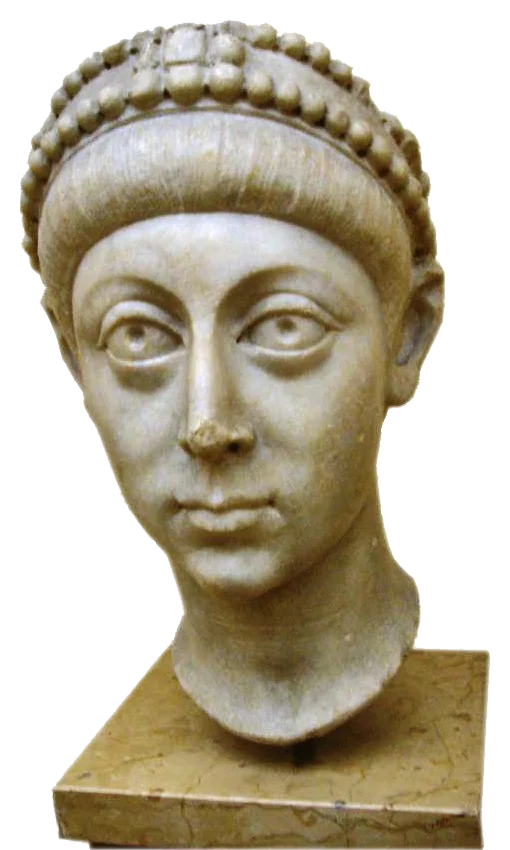
Arcadius
Arcadius ruled the eastern half of the Roman Empire for thirteen years, first as a young heir and then as emperor after the death of his father, Theodosius I. His reign saw ambitious court officials compete for influence, Gothic forces move through the Balkans, and Constantinople strengthen its role as the eastern imperial capital. The empire was administered through eastern and western courts, though it remained a Roman political world rather than two neatly separate states.
A prince in a changing empire
Arcadius was born in 377, the elder son of Theodosius and Aelia Flaccilla. In 383, while still a child, he was proclaimed Augustus, giving him imperial rank. His younger brother Honorius was later elevated as well. Theodosius entrusted Arcadius with responsibilities in the East and Honorius with the West, preparing his sons to govern the two major regions of the empire.
When Theodosius died in 395, Arcadius became emperor in the East, with his court based at Constantinople. He was about eighteen, and senior officials quickly emerged as the real power behind imperial decisions. The praetorian prefect Rufinus, who had served as a leading adviser, was killed by soldiers in 395. The court chamberlain Eutropius then rose to prominence and arranged Arcadius’s marriage to Eudoxia, the daughter of a Frankish military officer.
A court shaped by rivals
The eastern court was a center of political maneuvering. Eutropius was removed and executed in 399 after losing support, while Eudoxia became increasingly influential. Their political conflicts played out against unrest and military pressure. The Gothic leader Alaric campaigned in the Balkans in the 390s, and in 400 the Gothic general Gainas briefly seized control of Constantinople before being defeated. These events revealed the difficulty of balancing the army, the court, and the diverse populations of the empire.
Religious disputes also shaped Arcadius’s reign. John Chrysostom, the influential bishop of Constantinople, clashed with Eudoxia and other members of the court. He was deposed and sent into exile in 404. The episode reflected the growing importance of Constantinople’s bishop and the sometimes bitter struggle between ecclesiastical authority and imperial politics.
A quiet emperor and a lasting transition
Arcadius appears in the sources as reserved and often overshadowed by his advisers. Yet the emperor’s public role and decisions remained important symbols of authority. His reign helped consolidate Constantinople as the center of eastern Roman government, and the city continued to grow in administrative and religious importance.
Arcadius died in 408, leaving the throne to his young son, Theodosius II. His wife Eudoxia had died four years earlier, and a new group of officials, led by the praetorian prefect Anthemius, governed on the boy’s behalf. Arcadius’s life is often told through the powerful figures around him, but his reign marked a crucial transition: the eastern imperial court survived succession and political turbulence, and the empire’s eastern institutions continued on their own course for centuries.


