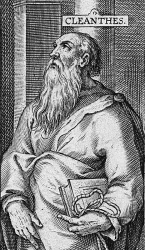
Arcesilaus
- From Pitane to Plato’s Academy
- A Socratic Method of Questioning
- Challenging the Stoics
- Living Without Certainty
- An Enduring Legacy
Arcesilaus helped turn Plato’s Academy into one of antiquity’s leading centers of philosophical skepticism. Rather than announce a system of his own, he tested other people’s claims through questioning and argument, often pressing them to admit that their certainty exceeded their evidence. His challenge to the Stoics helped shape debates about knowledge, belief, and how to act when certainty remains out of reach.
From Pitane to Plato’s Academy
Arcesilaus was born around 315 or 314 BCE in Pitane, a Greek city in Aeolis on the coast of Asia Minor, in what is now northwestern Turkey. Ancient accounts say he studied geometry and astronomy before traveling to Athens. There he first pursued rhetoric and then joined Plato’s Academy, where he studied with Crantor, Polemo, and Crates.
When Crates died, Arcesilaus became head, or scholarch, of the Academy. He led the school for more than 25 years, until his death around 241 or 240 BCE. The Academy had been founded by Plato, but under Arcesilaus it became known for a more openly skeptical approach to philosophical claims.
A Socratic Method of Questioning
Arcesilaus wrote no philosophical books. What is known of his ideas comes through later writers, including Cicero, Sextus Empiricus, and Diogenes Laertius, as well as reports preserved by philosophical opponents. These sources often disagree, so modern scholars remain cautious about assigning him a fixed doctrine.
The clearest account of his practice is dialectical: he would take up an argument offered by an interlocutor and test it from within, using premises that person accepted. The method recalled Socrates, who exposed contradictions in claims to knowledge without necessarily replacing them with a final answer. Arcesilaus’s aim may have been to keep inquiry open, to show that a position was not yet proven, or both.
Challenging the Stoics
Arcesilaus’s most prominent opponents were the Stoics, especially their account of how reliable knowledge could be achieved. They argued that some impressions of the world were so clear and distinct that a wise person could recognize them as true and assent without error. Arcesilaus challenged whether such a guaranteed criterion of truth could be identified.
According to later reports, his arguments suggested that for every impression that seemed true, a similar impression could be false. If no impression could be guaranteed to reveal truth, then a person should suspend judgment rather than claim certainty. This position became associated with Academic skepticism and influenced the direction of Plato’s school.
It remains debated whether Arcesilaus personally believed that nothing could be known or whether he used skeptical arguments mainly to test the claims of others. Some ancient accounts attribute to him the view that knowledge is impossible and that one should suspend assent in all matters. Others emphasize his Socratic practice and argue that he avoided affirming even that conclusion. The surviving evidence does not settle the question.
Living Without Certainty
Skepticism raises a practical problem: if a person refuses to declare beliefs true, how can that person decide what to do? Ancient writers report that Arcesilaus addressed this challenge by arguing that action need not depend on absolute certainty. People can respond to what appears reasonable or appropriate without treating the appearance as infallible knowledge.
The details of this account are also disputed, but the question itself became central to later skeptical philosophy. Arcesilaus helped make the Academy a place where theories of truth had to answer not only how knowledge was possible, but also how people could live when certainty could not be secured.
An Enduring Legacy
Arcesilaus left no surviving works, but his influence shaped the Academy for generations. Later skeptical thinkers, especially Carneades, extended the debates he had begun. Stoic philosophers also had to refine their accounts of perception and knowledge in response to his objections.
His legacy is not a single doctrine so much as a disciplined habit of doubt. By asking whether an argument truly justified assent, Arcesilaus changed the work of Plato’s Academy and helped establish skepticism as a lasting tradition in ancient philosophy. His example continues to invite a useful question: when evidence supports more than one conclusion, how confident should we be?