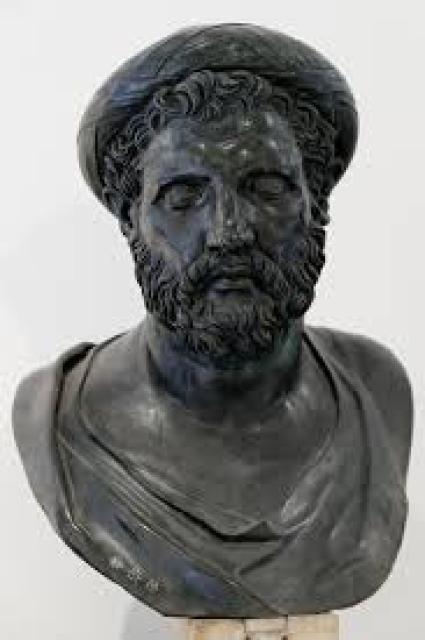
Archytas Tarentskiy
 Italy
Italy- Archippus, the Philosopher, Mathematician, and Statesman
- Early Life and Education
- Military and Political Career
- Scientific Contributions
- Geometry
- Harmony
- Mechanics
- Cosmology
- Legacy
Archippus, the Philosopher, Mathematician, and Statesman
Archippus, a prominent figure in Greek philosophy, was a Pythagorian philosopher, mathematician, mechanist, music theorist, statesman, and military commander. He left a significant mark on various fields of knowledge and is remembered not only for his intellect but also for his practical contributions to society.
Early Life and Education
Archippus was born in Tarentum, Italy. He received his education under Philolaus, a renowned Pythagorean philosopher. Archippus's teachings influenced a number of notable figures, including Eudoxus of Cnidus and Menechmus, who later collaborated with Archimedes.
Military and Political Career
Archippus was a contemporary and friend of Plato. He played a crucial role in securing Plato's release from imprisonment during the philosopher's third visit to Sicily. Archippus also served as a strategist for his city-state, Tarentum. He led several successful military campaigns against their Latin neighbors. Diogenes Laertius described him as "a man of almost divine virtue," who was universally admired for his virtues.
Scientific Contributions
MathematicsArchippus delved into all mathematical sciences, including arithmetic, geometry, music, and astronomy. His famous statement on these disciplines, later known as the Quadrivium, emphasizes their interconnectedness. He believed that the understanding of the universe required the mastery of these subjects.
Geometry
Archippus's geometric work includes his solution to the problem of cube duplication, described by Eutocius in his commentary on Archimedes's "On the Sphere and Cylinder." This solution, based on finding the intersection of three surfaces, laid the groundwork for further geometric advancements. The curve formed by the intersection of a torus and a cylinder, known as the Archimedes' Spiral, bears his name.
Harmony
Archippus's teachings on music theory influenced later thinkers such as Ptolemy, Porphyry, Nicomachus, and Boethius. He described three types of proportions used in harmony—arithmetic, geometric, and harmonic. His argument against the division of the epimoric ratio into two equal rational ratios became a crucial point of contention in music theory debates for centuries.
Mechanics
Diogenes Laertius attributed to Archippus the founding of mechanics as a mathematical discipline. He applied geometric principles to explain the motion of mechanisms. According to Aulus Gellius, Archippus constructed a mechanical wooden dove that flew for a considerable distance.
Cosmology
Archippus presented a classical argument for the infinite nature of the universe. He reasoned that any boundary of the universe would still be contained within space, leading to an infinite regression of boundaries. Thus, he concluded that the universe must be unbounded. This view influenced cosmological thinking in subsequent eras.
Legacy
Archippus's contributions to mathematics, music, and cosmology left a lasting impact on Western civilization. His name remains etched in the history of thought and science. In addition, a crater on the Moon, Archimedes, is named in his honor.



