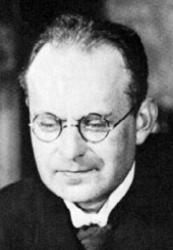
Aron Nimtsovich
 Denmark
Aron Nimzowitsch: Biography of a Chess Grandmaster and Theorist
Aron Isaevich Nimzowitsch (November 7, 1886, Riga - March 16, 1935, Copenhagen) was one of the greatest chess players and theorists in history, renowned for his contributions to the hypermodernist school of chess. Born into a wealthy trading family in Riga, little is known about his childhood. In 1896, the journal "Deutsches Wochenschach" reported on a nine-year-old boy in the Baltic region who stood out for his skillful play. The same journal published Nimzowitsch's first recorded game in 1904, spanning 213 pages.
Education and Career
Nimzowitsch studied philosophy in Berlin, but his true passion lay in chess, which he pursued at the "Kaiserhof" café. After the end of World War I, he settled in Denmark and obtained Danish citizenship. He spent the last 15 years of his life there, until his death from pneumonia on March 16, 1935. Nimzowitsch's most significant achievement was his victory in the Karlsbad tournament in 1929, where all the strongest chess players of the time participated, except for Lasker and Alekhine.
Chess Theory Contributions
Nimzowitsch's main contribution to the world of chess was as a theoretician. He wrote three groundbreaking works on chess theory: "My System" (1925), "My System in Practice," and "The Blockade." Savely Tartakower described Nimzowitsch's pursuit of flashy effects as his constant endeavor, but upon closer examination, one could appreciate the chess-philosophical depth behind Nimzowitsch's ideas guiding his experiments in opening theory.
According to Alexander Alekhine, those who truly understood Nimzowitsch as an artist and philosopher of chess were those familiar with his books. His last book, in particular, was highly interesting, illustrating his strategy with numerous examples and presenting it as a comprehensive system. Nimzowitsch's primary focus was on refining the principles established by Steinitz. While his predecessors, who had grasped Steinitz's ideas, sought victory purely through strategic means, Nimzowitsch relied on a combination of strategic thinking and combination play. After Steinitz's teachings had conquered the minds of chess players, combinations were regarded with disdain. It was believed that a player who avoided the traps set by combination enthusiasts would inevitably win, as an inclination towards sharp attacking combinations would weaken one's position. However, Nimzowitsch proved that combinations could serve as the logical conclusion of positional advantage. He and other chess players who possessed an unconventional style of play were later referred to by Tarasch as hypermodernists.
Legacy and Influence
It would be inaccurate to claim that Nimzowitsch established his own school. The term "hypermodernists" was applied at the time to anyone who, while developing Steinitz's teachings, played rather eccentrically for that era. If Nimzowitsch's experiments failed, his contemporaries labeled his style of play as artificial and decadent. However, when he achieved significant successes, he was hailed as the greatest strategist of the time. Nimzowitsch's strategic research began with a reassessment of Tarasch's principles, which many had adopted dogmatically. For instance, Tarasch clearly overestimated the role of central pawns in the opening. Nimzowitsch demonstrated that seizing control of the center in the opening, a crucial part of Steinitz's positional teachings, could also be achieved with the help of pieces, without necessarily having pawns and pieces directly on the central squares. Furthermore, he believed that a pawn in the center often hindered further development of initiative. Additionally, Tarasch exaggerated the disadvantages of a cramped position. Nimzowitsch, on the other hand, proved that in closed positions, where the side with positional advantage and space could not make a breakthrough, the advantage would shift to the side in a cramped position.
Nimzowitsch's name is associated with a variation of the Indian Defense, where Black moves the bishop to b4.