Arsen Savadov
 Ukraine
- Arsen Savadov: Ukrainian Artist and Provocateur
- "Donbass-Chocolate" (1997)
- "Fashion at the Cemetery" (1997)
- "Marxism de Sade" (1998)
- "The Book of the Dead" (2001)
- "Collective Red" (1998-1999)
Arsen Savadov: Ukrainian Artist and Provocateur
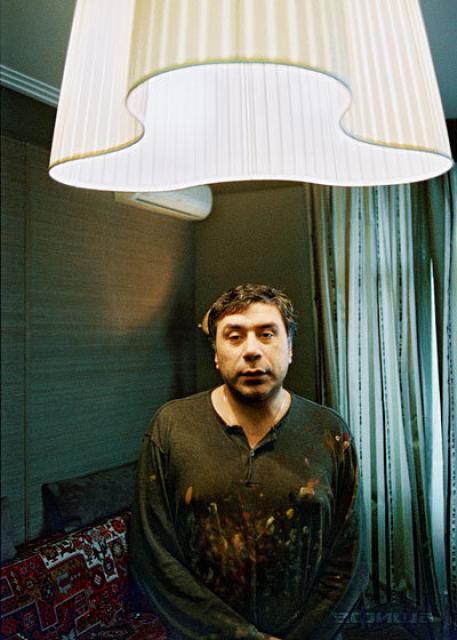
Arsen Savadov is a Ukrainian artist known for his provocative and controversial works. Born in 1962 in Kyiv, he comes from a family of artists, with his father being a renowned graphic artist whose works were displayed in Brezhnev's office. From a young age, Savadov's mother recognized his talent and encouraged him to pursue art.

Early recognition came to the artist when, in 1987, he gained fame for his collaboration with Georgiy Senchenko on the painting "Cleopatra's Sorrow," which garnered significant interest beyond the USSR. This marked the beginning of the Ukrainian transavantgarde movement. In the early 1990s, Savadov transitioned from painting to photography, gaining further recognition for his provocative projects such as "Donbass-Chocolate" and "The Book of the Dead."

In recent years, Savadov has returned to painting, working in the postmodernist style. His paintings and photo projects often explore the theme of the human body, presenting grotesque, elegant, or eerie compositions. Savadov's provocative works evoke shock, disgust, and admiration simultaneously, offering viewers a taste of the forbidden fruit.
Savadov's art has gained international recognition, with his paintings being acquired by museums in Paris, New York, Moscow, and private collectors. In 2015, his painting "No time to waste" sold for $19,000 at a Sotheby's auction. He represented Ukraine at the 49th Venice Biennale.

"Donbass-Chocolate" (1997)
One of Arsen Savadov's most well-known photo projects, "Donbass-Chocolate," features actual miners dressed in ballet tutus. This project garnered global attention and even business publications attempted to interpret its meaning. The idea behind the project was to combine two symbols of the Soviet system, miners and ballet, resulting in a strange, absurd, yet lively composition.
Interesting fact: The miners were paid $20 for their participation in the project. However, convincing them to exchange their briefs for ballet tutus was not an easy task. The team had to engage with the miners, share meals, and even descend into the dark and suffocating mines to gain their trust and interest in the project.
"Fashion at the Cemetery" (1997)
Another controversial photo project by Savadov, "Fashion at the Cemetery," features models posing in high-end couture garments against the backdrop of real funerals. Each photograph includes captions indicating the brand and price of the clothing worn by the models.
Savadov aimed to create a powerful social commentary through this series. He believed that the wealthy elite often remained indifferent to the struggles of others. The juxtaposition of fashion and grief highlighted the stark contrast between materialistic desires and human tragedy.
Interesting fact: To capture the models in their couture garments, the photography team used telescopic lenses from cars. If the mourners had noticed the photo shoot, it could have led to a violent confrontation. The team had to pay $5 per minute of shooting to the workers who dug the graves.
"Marxism de Sade" (1998)
The title of the project itself explains the narrative of the photographs. Savadov's works often incorporate communist symbols and references to Soviet ideals. The characters in "Marxism de Sade" are depicted as naive bunnies and mushrooms, ready to submit and comply with any request. Bunnies are popular characters in Soviet children's events, and mushrooms symbolize nuclear mushroom clouds from the era of the Cold War.
"The Book of the Dead" (2001)
This series is shocking and horrifying. At first glance, the viewer may not believe that the photographs depict actual corpses. Savadov arranged the bodies of deceased individuals in various compositions: a man reading a book to a child, someone lost in thought or engaged in conversation. This series was never exhibited in Ukraine and was intended for Western audiences.
Interesting fact: Savadov has remained secretive about the locations where he took the photographs for this project. He has had to be cautious in his comments due to potential charges of promoting violence. During an exhibition in Moscow, part of the set, including a chair in which a deceased man was "reading" a book, was displayed. Visitors unknowingly sat in the chair before realizing its connection to the photographs, resulting in immediate discomfort.
"Collective Red" (1998-1999)
In the first part of this project, Savadov photographed fashionably dressed bullfighters interacting with workers in a blood-soaked slaughterhouse. The second part featured photographs of veterans alongside their grandchildren, proudly holding crimson flags adorned with communist symbols and portraits of fallen leaders.
Savadov considers all his projects as part of a larger anthropological exploration, where characters transition from one project to another, similar to characters in Fellini's film "La Dolce Vita." His works challenge societal norms and offer a reflection on the human condition.