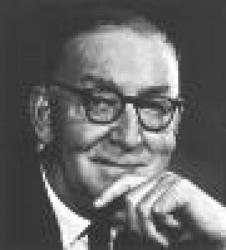
Artur Komton
 USA
USABiography of Arthur Compton
Arthur Holly Compton was an American physicist born in Wooster, Ohio. He was born to Elias Compton, a Presbyterian minister, professor of philosophy, and dean of Wooster College, and Otelia Catherine (Ogspurger) Compton. Growing up in an intellectual family, Arthur developed an early interest in natural sciences, collecting butterflies, studying paleontology, and reading books on astronomy. He completed his undergraduate degree at Wooster College in 1913 and became a physics graduate student at Princeton University, earning a Master's degree in 1914. Two years later, he received his Ph.D. by writing a dissertation on the interaction of X-rays with matter.
Compton worked as a physics instructor at the University of Minnesota for a year, and then served as a research engineer at Westinghouse Lamp Company in Pittsburgh for two years. Here, he worked on the development and construction of a lamp containing sodium vapor, and later assisted in creating aviation instruments for the military after the United States entered World War I. While at Westinghouse, he continued his study of X-rays, which eventually led to the discovery of the effect that was later named after him. In 1919, Compton accepted a fellowship from the National Research Council and spent a year at the Cavendish Laboratory at the University of Cambridge. It was an exciting time as he witnessed Ernest Rutherford's early experiments on atomic splitting, which later became a decisive factor in his scientific career.
Upon returning to the United States in 1920, Compton became the head of the physics department at Washington University in St. Louis, where he conducted his most famous experiments. Using the X-ray spectrometer developed by W.H. Bragg, he made precise measurements of the wavelength of X-rays scattered by a target. Compton discovered that the scattered radiation had two components: one with the same wavelength as the incident radiation, and another with a longer wavelength. The increase in wavelength, known as the Compton effect, was proportional to the scattering angle. Once again, Compton's results could not be explained by classical physics, but this time he made a decisive step by turning to quantum theory. He discovered that the increase in wavelength could be explained by considering X-rays as particles with energy and momentum values predicted by quantum theory. When an X-ray particle, or quantum, collided with an electron in the target, it transferred part of its energy to the electron, resulting in lower energy and longer wavelength radiation. This new discovery by Compton aligned with his earlier finding that scattered gamma rays are more easily absorbed by matter than primary gamma rays; low-energy (longer wavelength) radiation is more easily absorbed than high-energy (shorter wavelength) radiation. Since light, like X-rays, is a form of electromagnetic radiation, the Compton effect provided strong support for Einstein's 1905 proposal that light has both wave and particle properties. The corpuscular properties of electromagnetic radiation were observed when the primary X-rays interacted with electrons, while the wave properties were detected when the scattered rays were detected - the action of the spectrometer can only be explained by considering X-rays as waves.
In 1923, Compton published his results and the same year he became a professor at the University of Chicago. He proposed that electrons, on which the scattering occurred, were ejected from atoms with high velocities. These recoiling electrons, as Compton called them, were later confirmed and experimentally verified by C.T.R. Wilson in the same year using his invention of the cloud chamber, which allowed the observation of tracks made by charged particles. Compton's findings generated excitement among physicists, but his quantum interpretation was not immediately accepted as it contradicted J.J. Thomson's ideas. American physicist William Duane objected to Compton's theory and tried to show that Compton's data could be explained by other effects. Compton, Duane, and other physicists conducted additional experiments, and in 1924, Duane withdrew his objections, realizing that his own measurements were in excellent agreement with Compton's theory. The recognition of the Compton effect was a significant stimulus for the development of quantum mechanics, a complex mathematical interpretation of quantum theory with deep and far-reaching applications in physics and chemistry.
In the 1920s, Compton conducted other important research on X-rays. For instance, in 1922, he demonstrated that X-rays can be completely reflected by smooth surfaces such as glass or metal, thus showing that X-rays behave similarly to light. In 1925, Compton, along with his colleagues, obtained this effect using a diffracting grating spectrometer, which allowed them to separate scattered X-rays into components with corresponding wavelengths. Their work laid the foundation for the study of X-rays as a branch of optics, and this alone earned Compton a reputation as an outstanding scientist. In 1927, Compton received the Nobel Prize in Physics "for the discovery of the effect named after him." He shared the prize with C.T.R. Wilson. In presenting the laureates, Kai Siegbahn of the Royal Swedish Academy of Sciences noted that the Compton effect "is now so important that no atomic theory can be accepted in the future unless it agrees with it and follows the laws established by its discoverer."
After receiving the prize, Compton focused on developing methods for experimentally studying the distribution of electrons in atoms. Along with measuring the energy of X-rays, this work laid the foundation for subsequent theories of atomic structure. Compton's experimental research also contributed to the understanding of the magnetic properties of ferromagnetic materials such as iron. In the early 1930s, Compton became interested in cosmic rays (radiation from space reaching the Earth), as the interaction of gamma rays and electrons in cosmic rays provided an important example of the Compton effect. Between 1931 and 1933, he led expeditions to various parts of the world to gather data on cosmic rays. Based on this information, he confirmed Jacob Clay's early conclusions about the variation in cosmic ray intensity depending on geographic latitude. Compton correctly explained this variation by showing that, contrary to prevailing opinion, cosmic rays are influenced by Earth's magnetic field and consist, at least in part, of charged particles.
In 1941, Compton became the head of the physics department and dean of the division of physical sciences at the University of Chicago. That same year, he chaired the National Academy of Sciences committee created to study the possible military use of atomic energy. The favorable report of this group led to the approval of the Manhattan Project. From 1942 to 1945, Compton served as the director of one of the project's divisions, known as the Metallurgical Laboratory at the University of Chicago. It was there that the first nuclear reactor was built under the guidance of Enrico Fermi. Later, Compton supervised the construction of the Oak Ridge National Laboratory in Tennessee, which was responsible for the separation of uranium-235 from the more abundant uranium-238.
When offered the position of president of Washington University in 1945, Compton decided to accept the offer and leave Chicago, even though it meant the end of his research work. After stepping down as university president in 1954, he remained an honorary professor of physics at Washington University. He left that position in 1961, intending to split his time between Washington University, Wooster College, and the University of California, Berkeley.
In 1916, Compton married Betty Charity McLoskey, and they had two sons. His wife was a loyal assistant in his work throughout his life, and during World War II, she even received security clearance to work alongside him at his insistence. Compton was a bright and remarkable individual, capable of igniting enthusiasm in his students and colleagues. He was sincerely religious and led the Laymen's Missionary Movement from 1934 to 1948. He also actively participated in the work of the National Conference of Christians and Jews. Compton died from a cerebral hemorrhage on March 15, 1962, in Berkeley, California.
Among Compton's numerous awards, he received the Rumford Medal of the American Academy of Arts and Sciences (1927), the Hughes Medal of the Royal Society of London (1940), the Franklin Medal of the Franklin Institute (1940), and the Medal for Merit from the United States government (1946). He received honorary degrees from many universities, including Yale, Princeton, and Harvard. Compton was a member of the American Association for the Advancement of Science, the American Philosophical Society, the American Physical Society, the National Academy of Sciences, and the New York Academy of Sciences, as well as a member of more than 20 foreign scientific societies.