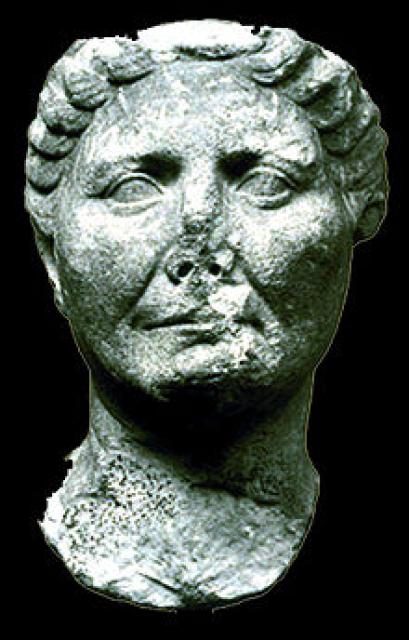
Atiya Tsezoniya
 Italy
ItalyBiography of Atia Caesaris
Atia Caesaris was the niece of Julius Caesar and the mother of Emperor Octavian Augustus. She was the middle child of Julia Caesaris Minor, sister of Julius Caesar, and Marcus Atius Balbus, a praetor in 60 BCE and a cousin of Pompey the Great. Atia and Marcus had three children. The most common belief is that they were all girls - Atia Balba Prima, Atia Balba Caesonia, and Atia Balba Tertia. However, according to Ronald Syme [1], they had a son named Marcus Atius Balbus (promagistrate in 38 BCE) and two daughters - Atia Major and Atia Minor.
Marriage to Gaius Octavius
Around 70 BCE, Atia Balba Caesonia, at the age of fifteen, married Gaius Octavius, a supporter of Caesar and a renowned military commander who served as a praetor in 61 BCE. This was Octavius' second marriage, as he already had a daughter named Octavia Major from his first wife, Ancharia, who likely passed away, leaving him a widower.
Children and Death
In 69 BCE, Atia and Gaius Octavius welcomed a daughter named Octavia Minor, and in 63 BCE, they had a son named Gaius Octavius Thurinus, who would later become the emperor Augustus. Unfortunately, in 59 BCE, Gaius Octavius passed away on his way to Rome.
Around 57 BCE, Atia remarried Lucius Marcius Philippus, a patrician and consul in 56 BCE. In this marriage, she focused on raising her two children and two stepchildren from Lucius Marcius' previous marriage. In 43 BCE, during the first consulship of her son, Atia passed away. Octavian organized lavish funerals and games in her memory.
Influence and Reputation
Lucius Marcius Philippus later married Atia's younger sister, Atia Balba Tertia. Atia herself had little influence on the political affairs of her husbands and son. However, she cared deeply about Octavian's well-being and convinced him to decline the honor of being Julius Caesar's heir.
Atia is mentioned in the works of Tacitus [2], where she is described as one of the "exceptionally religious and moral, most admirable matrons of the republic." She is also mentioned by Suetonius [3] in relation to the signs that preceded the birth of Octavian.