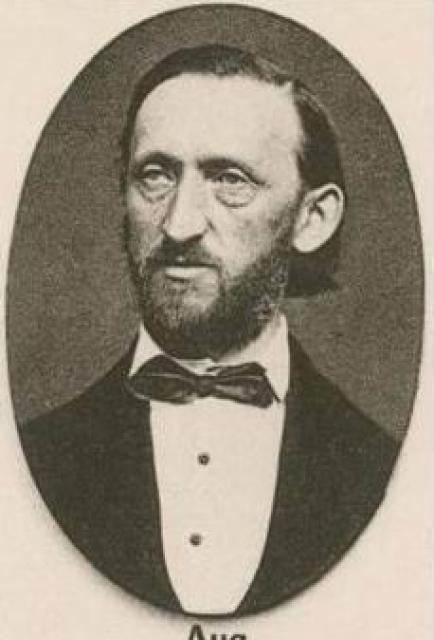
August Conradi
 Germany
August Conradi was a prolific composer whose career bridged serious instrumental music and the lively popular theatre of nineteenth-century Berlin. He wrote symphonies, organ and piano music, songs, church music, operas, ballets, and a large body of comic stage works. Today he is often remembered as an associate of Franz Liszt, but in his own city he became especially known for helping turn Berlin’s musical farce into a distinctive theatrical genre.
Training and Early Career
Born in Berlin on June 27, 1821, August Eduard Moritz Conradi was the son of a police sergeant and a mother whose father had been a schoolteacher. His early musical education brought him into contact with leading figures in Berlin’s musical life. At the Royal Academy of Arts he studied organ, piano, harmony, and composition with August Wilhelm Bach, Eduard Grell, and Carl Friedrich Rungenhagen. In 1841 he travelled to Weimar for a brief period of study with Franz Liszt, a connection that would continue in later professional work.
In 1843 Conradi became organist at the Invalidenhaus church in Berlin. He was already composing orchestral works, including symphonies, and his fourth symphony brought him unexpected attention when he was invited to Vienna to conduct it after the score had been improperly used as someone else’s work. The incident helped establish his name beyond Berlin. His Zigeunerpolka, Op. 5, also attracted notice; Liszt later made a piano transcription of it.
Conradi’s association with Liszt extended beyond lessons. In the 1840s he worked as a musical assistant and copyist in Weimar, and later scholarship has often remembered him chiefly in that role. Yet the partnership was only one part of a substantial career of his own. His early symphonies show an ambition toward large-scale instrumental composition, even though researchers have found the five symphonies difficult to trace and several appear to be lost.
Theatre Conductor and Composer
Conradi’s professional life increasingly centered on the theatre. He held conducting posts in Berlin, Stettin, Düsseldorf, and Cologne, gaining experience with different ensembles and audiences. By 1858 he was again based permanently in Berlin, where he worked as conductor and composer for the Kroll Theatre, the Neues Königstädtisches Theater, and the Wallner Theatre.
These stages relied on topical comic theatre, songs, dance, and musical scenes that could respond quickly to urban life. Conradi became a leading composer of the Berlin Posse, a popular form of theatrical comedy. His music gave the genre a fuller musical identity, moving it beyond its roots in burlesque street song and making greater use of melodrama. He also collaborated for a time with French composer Jacques Offenbach, whose operettas were reshaping European musical theatre.
The scale of Conradi’s output was remarkable. He wrote around fifteen stage compositions in 1859 alone, alongside symphonies, piano works, songs, and church music. Among his better-known theatre pieces were Die Revolution der Frösche, a 1849 work with political allusions, and later works such as Berlin wie es weint und lacht, Einer von unsere Leut, and Faust und die schöne Helena. The range of titles reflects his ability to move between topical satire, local color, and parody of grander literary and operatic subjects.
Family and Later Years
In 1855 Conradi married Emma Stephan, the daughter of a porcelain painter. The couple had no children. He continued to work in Berlin’s theatre world until his death there on May 26, 1873, aged 51. His productivity was such that biographical accounts describe an enormous number of stage works, many written for companies whose schedules demanded new material at a rapid pace.
Conradi’s legacy has two complementary sides. The symphonic works reveal a composer who sought recognition in the instrumental tradition, while the theatre music made him a central figure in the popular culture of Berlin. His surviving archive at the Berlin State Library includes fourteen volumes of autograph compositions and a large collection of copied scores and performance materials from the Königstädtisches Theater. The five symphonies remain difficult to locate, but the manuscripts and theatre records preserve the evidence of a working musician whose influence was felt night after night on the city’s stages.
The honorific sometimes attached to him, “a classic of the Berlin Posse,” captures the part of his career that reached the broadest contemporary audience. Conradi helped shape an urban musical theatre that could entertain, satirize, and respond to current events, while his contact with Liszt linked him to the more prestigious world of European instrumental composition. His story is a reminder that nineteenth-century musical life was built not only in concert halls, but also in busy theatres where a prolific composer had to keep the next performance ready.


