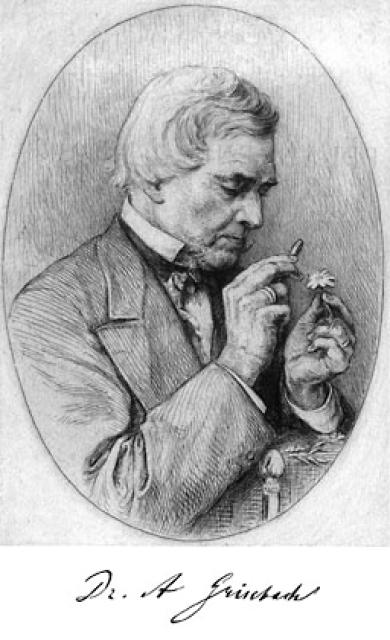
August Grisebach
 Germany
- German Botanist
- Education and Early Career
- Explorations and Botanical Research
- Professor and Botanical Director
- Contributions to Plant Science
- Establishing the concept of "plant formation"
- Collaborations and Recognition
German Botanist
August Heinrich Rudolf Grisebach was a German botanist known for his contributions to plant systematics and geography.
Education and Early Career
Grisebach studied botany and pharmacy at the University of Göttingen and the University of Berlin. He earned a doctorate in medicine in 1836 and became a private lecturer in botany at the University of Göttingen in 1837.
Explorations and Botanical Research
In 1839-1840, Grisebach explored the Balkan Peninsula and northwestern Asia Minor, studying and describing the local flora in detail. His book "Reise durch Rumelien und nach Brussa im Jahre 1839" remains a valuable source on the history and geography of Bulgaria and Western Turkey.
Professor and Botanical Director
From 1841, Grisebach served as a professor of natural history at the University of Göttingen. He conducted expeditions to Norway, the Pyrenees, and the Carpathian Mountains. In 1847, he became a professor and in 1857, the director of the university's Botanical Garden.
Contributions to Plant Science
Grisebach's key contributions included:Expanding Humboldt's list of plant forms to 60
Introducing the term "geobotany" (independently of F.I. Ruprecht) to describe plant geography
Establishing the concept of "plant formation"
Using climatic differences as a basis for dividing the Earth's vegetation into different regions
Collaborations and Recognition
Grisebach collaborated on major botanical works such as Ledebour's "Flora rossica," De Candolle's "Prodromus," and Martius' "Flora brasiliensis." He was a corresponding member of the Prussian Academy of Sciences in Berlin and the German Academy of Natural Sciences "Leopoldina."


