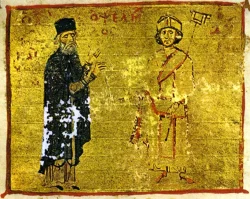
Aurelius Victor
- From North Africa to imperial service
- A historian recognized by Julian
- The long road to Rome
- A history preserved in fragments
Sextus Aurelius Victor rose from an obscure provincial background to become one of the most prominent Roman historians and officials of the fourth century. His surviving historical work offers a compact, sometimes sharp-eyed account of Rome’s emperors, while his own career carried him from provincial administration to the highest civic office in the capital. Victor’s life is known only in fragments, but those fragments tell an unusual story of literary achievement and political advancement in the later Roman Empire.
From North Africa to imperial service
Victor was born in North Africa, probably in the early fourth century. He described himself as coming from a rural family of modest means, and later writers identified him as Victor the African. He nevertheless received a strong education, perhaps in Carthage, Rome, or both. His exact path into government is not recorded, but he appears to have entered imperial service as a bureaucrat and was working in the Balkans by the 350s.
In about 360, Victor completed a history of Rome that reached the reign of Constantius II. Its account moved through the emperors from Augustus onward, combining a narrative of political change with assessments of rulers and their character. Victor wrote in a period of intense religious and political transition, when the Roman world was reshaped by emperors with competing visions of the state. His writing showed an interest in the way imperial rule had transformed Roman institutions and in the qualities that made a ruler effective or dangerous.
A historian recognized by Julian
Victor’s career took a remarkable turn in 361, when he met the emperor Julian during the latter’s march through the Balkans. Julian reportedly admired his work, honored him with a bronze statue, and appointed him governor of Pannonia Secunda, a province in the region of modern Hungary and Serbia. The appointment demonstrates how literary reputation could open doors to senior public office.
Victor’s historical writing did not simply flatter those in power. He could be critical of emperors, including Constantine and Theodosius, and used comparison with earlier Roman history to examine how authority and civic life had changed. His style was shaped in part by the historian Sallust, but his subject was the evolving imperial system around him. The historian Ammianus Marcellinus later praised Victor’s temperance, and the Christian writer Jerome also knew his work.
The long road to Rome
Little is known of Victor’s career for several decades after his governorship. In 389, under Emperor Theodosius I, he became Prefect of the City of Rome, one of the most prestigious posts in the imperial administration. The office placed him in charge of civic matters in the capital and gave him a prominent public role. An inscription from a statue base records his dedication to Theodosius, while the statue itself honored the emperor. Victor’s elevation, first by the pagan Julian and later by the Christian Theodosius, suggests that his skill and reputation bridged very different political climates.
The date of Victor’s death is unknown. His influence, however, outlasted his lifetime. Later writers read and drew upon his history, and his work became part of the tradition through which medieval readers encountered Rome’s imperial past.
A history preserved in fragments
The texts associated with Victor have a complex history. Manuscripts preserve short works commonly known as the De Caesaribus and the Epitome de Caesaribus. For centuries, scholars treated one as Victor’s complete surviving history and the other as an anonymous summary that borrowed from him. Recent research has argued instead that both are abridgments of a much larger history by Victor, with one preserving extracts and the other rewriting material from it. The original work has not survived intact, but these later texts offer glimpses of its scope and reputation.
Aurelius Victor remains a figure at the intersection of writing and power. His journey from a provincial upbringing to the prefecture of Rome was extraordinary, and his account of emperors helped shape how later generations understood the transformation of the Roman state. The brevity of the works linked to him can conceal the standing he enjoyed in his own time: to his contemporaries, he was not merely a compiler of imperial biographies, but a historian whose learning earned him honors, influence, and high office.