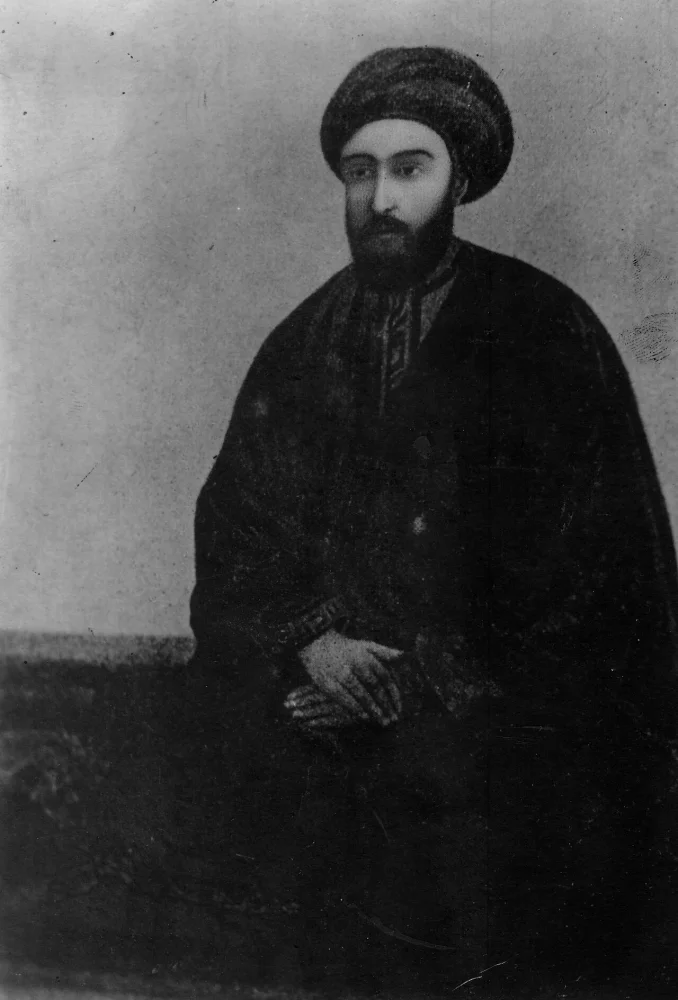
Báb
The Báb was a Persian religious leader whose brief ministry transformed a circle of spiritual seekers into a movement that spread across nineteenth-century Iran. His teachings began within the world of Shi‘i Islam but developed into a distinct religious message. Executed by the Qajar government in 1850, he became the central figure of Bábism and, in Bahá’í tradition, the herald of a new religious age.
From merchant to spiritual teacher
Born Siyyid ‘Alí-Muhammad in Shiraz on October 20, 1819, he came from a family connected with trade. As a young man, he worked in commerce and encountered the Shaykhi school, a current within Shi‘i Islam that emphasized expectation of the return of the Hidden Imam. Its followers looked for a spiritual guide who would prepare the way for that return.
In May 1844, he announced to the scholar Mullá Husayn that he was the Báb, an Arabic title meaning “Gate.” His first claim was that he served as a channel to the Hidden Imam. The announcement became the starting point of a new movement. Followers, known as Bábís, carried his message to towns across Iran, attracting converts and provoking opposition from established religious and political authorities.
An expanding religious message
The Báb wrote extensively, producing commentaries, prayers and works of religious law. His writings developed rapidly. Over time, he made a more expansive claim, presenting himself not only as the Gate but as a divinely inspired messenger who inaugurated a new religious dispensation. The Persian Bayán, one of his major works, set out teachings and laws for the community.
This evolution sharpened the conflict around him. In 1847, the authorities sent him into confinement in the remote fortresses of Maku and then Chihriq in northwestern Iran. Even in prison, he continued to write and communicate with followers. The Bábí movement grew amid rising tensions, including clashes between Bábís and government forces.
Execution and legacy
In July 1850, the government ordered the Báb’s execution in Tabriz. He was killed by firing squad on July 9, though some historical accounts give July 8. His death did not extinguish the movement; his followers continued to preserve his writings and teachings, even as the community faced severe persecution.
The Báb’s influence also shaped the later Bahá’í Faith. Bahá’ís regard him as a Manifestation of God and as the forerunner of Bahá’u’lláh, who later declared a new mission among the Bábí community. The Báb’s remains were eventually brought to Mount Carmel, where his shrine now stands in Haifa.
A life lasting just thirty years, his career moved from merchant life to an extraordinary religious claim that challenged the boundaries of his time. The Báb remains a significant figure in modern Iranian religious history, remembered both as the founder of Bábism and as a spiritual precursor in Bahá’í belief.


