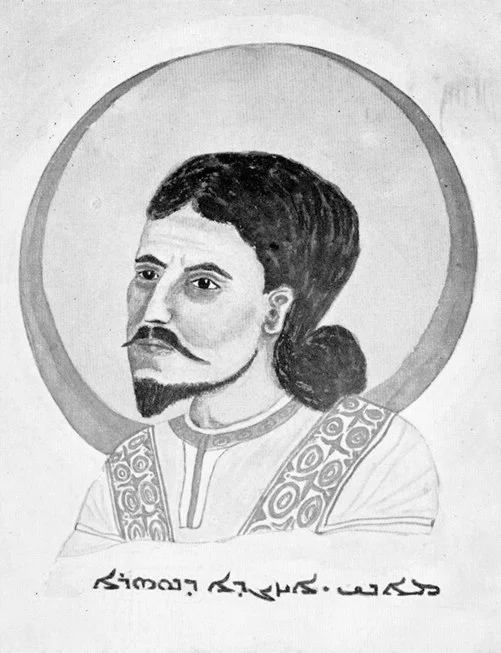
Mani
Mani was a religious teacher in the third-century Sasanian Empire whose teachings became the foundation of Manichaeism, a faith that spread from the Roman world to Central and East Asia. His message described the human condition as part of a cosmic struggle between Light and Darkness and drew on religious ideas circulating across Mesopotamia and Iran.
Early life and revelation
Mani was born in 216 CE in southern Mesopotamia, in the region of the Parthian Empire. His family belonged to a Jewish-Christian community, and he grew up among its practices. According to accounts preserved by his followers, he experienced revelations as a young man and came to see himself as a messenger whose teachings completed and clarified earlier religious revelations.
He began preaching publicly around 240, when the Sasanian dynasty had replaced Parthian rule. Mani traveled widely, including to regions east of Iran, and built a community of disciples who carried his message across political borders. He wrote in several languages and produced a body of texts intended to preserve and explain his teachings. Among them was the Shabuhragan, a book composed in Middle Persian and dedicated to King Shapur I.
The Manichaean teaching
Manichaeism taught that Light and Darkness were opposing principles whose mixture explained the world and the human condition. Human beings, in this account, could help release the Light trapped in material existence through knowledge, disciplined conduct, and spiritual practice. The religion developed an organized community with strict expectations for its ascetic elect and a wider circle of lay supporters.
Mani’s teaching drew from the religious landscape of late antiquity, including Christian, Iranian, and other traditions. It presented itself as a universal message and spread through missionary networks. In later centuries, Manichaean communities were found from the Roman Empire to Central Asia and China.
Persecution and legacy
Shapur I allowed Mani to preach, but after the king’s death the religious and political climate changed. Under Bahram I, Mani was imprisoned, and he died in 274 or 277; accounts differ on the date and circumstances. His followers preserved his writings and stories of his life, allowing the movement to outlast the founder by many centuries.
Although Manichaeism eventually disappeared as an organized religion, it left a wide record in texts and art from across Eurasia. Mani is remembered both as a religious founder and as a figure who sought to carry a single message across the diverse cultures of the ancient world.


