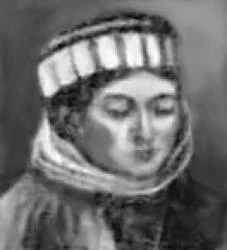
Basil of Caesarea
- Family and education
- A new direction: monastic life
- Bishop and theological leader
- Care for the poor and a lasting legacy
Basil of Caesarea was a thinker with a bishop’s responsibilities and an organizer with a monk’s discipline. In fourth-century Cappadocia, he shaped communal monastic life, defended the theology that would become central to Nicene Christianity, and built institutions for people in need. His letters and sermons reveal a leader who could move from intricate arguments about the Trinity to urgent questions of hunger, poverty, and public responsibility.
Family and education
Basil was born around 329 or 330 in Caesarea, the leading city of Cappadocia in the eastern Roman Empire. His family was wealthy, Christian, and unusually influential in church history. His grandmother Macrina the Elder had endured persecution; his parents were also named Basil and Emmelia. His siblings included Macrina the Younger, whose religious example deeply affected him, and Gregory of Nyssa, who became a leading theologian in his own right.
He studied rhetoric and philosophy in Caesarea, Constantinople, and Athens. At Athens he formed a close friendship with Gregory of Nazianzus, a fellow student who later became an important church leader and theological ally. Basil’s classical education gave him the tools to argue with precision, but his career would be shaped just as strongly by Christian ascetic ideals and service to the church.
A new direction: monastic life
After returning to Cappadocia, Basil was drawn toward a life of prayer and simplicity. He traveled through centers of ascetic practice in Egypt, Syria, and Palestine, then established a community in Pontus. His sister Macrina had already helped create a religious household on their family estate, and her example reinforced his decision to turn away from a conventional career.
Basil’s approach to monasticism favored communities rather than isolated displays of austerity. He encouraged prayer, study of scripture, manual work, and shared responsibility. His questions and answers on the ascetic life, later known as the Longer and Shorter Rules, became foundational texts for Eastern Christian monastic practice. Their influence extended beyond the East, helping shape the wider Christian tradition of communal religious life.
Bishop and theological leader
Basil was ordained a presbyter in the 360s and became bishop of Caesarea in 370. The appointment placed him at the center of Cappadocian church affairs and in the midst of the theological disputes that followed the Council of Nicaea. Some Christian leaders rejected or qualified the Nicene confession about the relationship between the Father and the Son; others disputed whether the Holy Spirit should receive the same divine honor.
Basil argued against Eunomius and other opponents of Nicene theology and wrote On the Holy Spirit to defend the Spirit’s divine status. He often chose careful language and patient coalition-building over slogans, a strategy that frustrated some allies but helped make agreement possible. Working with Gregory of Nazianzus and his brother Gregory of Nyssa, Basil helped clarify the language of Trinitarian theology. The three are remembered together as the Cappadocian Fathers.
His leadership also involved practical conflict. He resisted imperial pressure from the Arian-leaning emperor Valens and sought to preserve unity among divided Christian communities. Basil corresponded widely with bishops and officials, negotiating over appointments, doctrine, and the strained relationship between eastern churches. His surviving letters offer a rare view of how theology and politics intertwined in the fourth-century church.
Care for the poor and a lasting legacy
Basil’s work did not end with doctrinal writing. During famine, he organized aid and preached against the selfish accumulation of wealth. Near Caesarea he developed a large charitable complex, remembered as the Basiliad, that provided care for the poor and sick and hospitality for travelers. The project made visible his conviction that religious leadership required practical service.
Basil died in 379, worn down by illness and years of intense work. He was remembered almost immediately as a forceful bishop, a gifted preacher, and a defender of the faith. His writings on the Holy Spirit and monastic life remained influential for centuries, while his charitable institutions became a model of organized Christian care.
Today Basil is honored as a saint and one of the great Doctors of the Church. In Eastern Christianity he is known as Basil the Great, and the liturgy associated with his name is still celebrated on special feast days. His legacy unites scholarship, communal prayer, ecclesiastical leadership, and a demanding concern for the poor—an unusually broad vision of what a bishop could be.