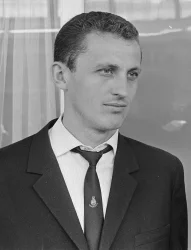
Béla Guttmann
Béla Guttmann spent a career in motion. The Hungarian Jewish footballer became a roaming manager whose teams won trophies in Europe and South America, but his greatest fame came at Benfica, where he guided the club to two consecutive European Cups. His life also crossed the upheavals of the twentieth century: he survived the Holocaust by hiding and escaping forced labor, then returned to football with a fierce appetite for success.
Early Life and Playing Career
Guttmann was born in Budapest on January 27, 1899, to a Jewish family. His parents taught dance, and he trained as a dancer before turning to football. He began his professional career with Törekvés and MTK Budapest. At MTK, he helped win Hungarian league titles in 1920 and 1921, and he represented Hungary internationally, including at the 1924 Paris Olympics.
Rising antisemitism in Hungary pushed him to Vienna, where he joined Hakoah Wien, a Jewish Zionist club. Hakoah won the Austrian championship in 1925, and its internationally popular team toured abroad. During a 1926 tour of the United States, Guttmann stayed in New York and played for American clubs, including the New York Giants and New York Hakoah. He also ran a dance school and invested in businesses, including Prohibition-era speakeasies. The Wall Street Crash wiped out much of his investment, and he returned to Europe.
From Player to Manager
Guttmann returned to Hakoah as a player and then moved into coaching. His first major managerial success came with Újpest in Hungary, which won the league and the Mitropa Cup in 1939. Anti-Jewish policies and the worsening political climate forced him to leave the club soon after its victories.
He spent the war years in Budapest. When Nazi Germany occupied Hungary in 1944, Guttmann was targeted as a Jew. He was hidden in an attic by the brother of his partner, Mariann, and later reported to a forced-labor camp. As the danger of deportation increased, he and several others escaped. He survived the final months of the war in hiding, though many members of his family were killed. He and Mariann married in 1945.
After the war, Guttmann rebuilt his career across a succession of clubs and countries. He coached in Hungary, Romania, Italy, the Netherlands, Brazil, and elsewhere. At Honvéd, he clashed with Ferenc Puskás and left after a dispute. At AC Milan, he was dismissed despite the team’s strong position in the league, reinforcing his reputation for volatile relationships with club officials. His teams, however, continued to win: he secured the Italian championship with Milan in 1955 and the São Paulo state championship in Brazil in 1957.
Benfica and European Glory
In 1958, Guttmann arrived in Portugal and led Porto to the league title. He moved to Benfica the following year and rapidly reshaped the team, placing greater trust in younger players. Benfica won the Portuguese league in 1960 and 1961, then defeated Barcelona 3–2 in the 1961 European Cup final.
The next season brought an even bigger triumph. Benfica beat Real Madrid 5–3 in Amsterdam in 1962, becoming European champions for a second year in a row. Guttmann also played a role in bringing the young Eusébio to the club, where the forward became one of football’s great stars.
The coach and Benfica’s board parted ways after a dispute over his contract and compensation. A story later took hold that Guttmann cursed the club, predicting it would not win another European trophy for a century. The tale became a favorite part of Benfica folklore as the team lost a series of later European finals. However, there is no contemporary evidence that Guttmann made the famous curse statement; the story appeared in the press decades after his departure.
Final Years and Legacy
Guttmann continued managing after Benfica, returning briefly to the club and coaching Peñarol, Panathinaikos, and other teams. His career was marked by movement and confrontation as much as by silverware. He was known for demanding authority over team decisions and for leaving when he felt that club officials had interfered or undervalued his work.
He died in Vienna on August 28, 1981, aged 82. Guttmann’s legacy rests on more than the Benfica legend: he was an international footballer, a survivor who rarely discussed his wartime experiences, and an inventive manager who won major titles across several countries. His restless career helped make the modern coach a powerful figure, while his two European Cups established his name in the history of the game.