Ben Jonson
 Great Britain
- Early Life and Education
- Theatre Career and Early Success
- "Comedy of Humours" and Controversies
- Tragedies and Masterpieces
- Masks and Courtly Entertainments
- Court Poet and Academic
- Legacy and Death
Early Life and Education
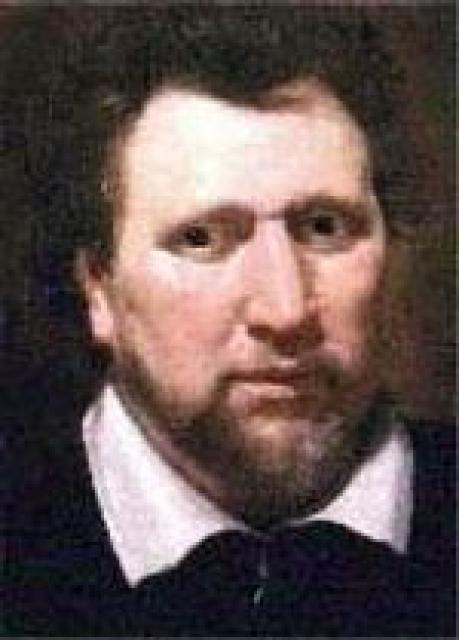
Ben (Benjamin) Jonson, renowned English playwright, was born on June 11, 1572, in Westminster, London, to a minister. He studied under the tutelage of W. Camden, a prominent scholar at Westminster Grammar School, where he mastered Greek and Latin. After a brief stint in his stepfather's shop (his father passed away shortly after his birth), he became a bricklayer and later joined the army.
Theatre Career and Early Success
Upon his return from military service, Jonson joined Philip Henslowe's London theater as an actor and playwrights' assistant, a role that included transcribing existing plays in the theater's repertoire. On November 14, 1594, Jonson married Anne Lewis.
In 1597, Jonson wrote his first play, "Every Man in His Humour," which premiered in 1598 (featuring William Shakespeare in the cast). In that same year, Jonson was arrested for his involvement in the satirical play "The Isle of Dogs" at The Swan Theatre, which mocked the authorities. After his release, he worked at The Rose Theatre.
"Comedy of Humours" and Controversies
With his next play, "Every Man Out of His Humour" (1599), Jonson pioneered the English "comedy of humours," where each character personifies a specific "humour" or vice (greed, lust, ambition). In subsequent years, Jonson wrote comedies such as "Cynthia's Revels" (1600) and "The Poetaster" (1601), in which he satirized fellow playwrights Thomas Dekker and John Marston. However, after reconciling, Jonson collaborated with Dekker on "The King's Entertainment" and with Marston and George Chapman on "Eastward Ho" (1605), which mocked the Scots who had arrived at James I's court, resulting in the authors' imprisonment.
Tragedies and Masterpieces
Jonson's first major tragedy, "Sejanus" (1603), featured performances by Burbage and Shakespeare. His other tragedy, "Catiline," was written later in 1611. In his middle age, Jonson produced his acclaimed comedies "Volpone, or The Fox" (1606), "The Alchemist" (1610), and "Bartholomew Fair" (1614).
Masks and Courtly Entertainments
From 1605 onwards, Jonson wrote masques, allegorical comedies designed for courtly entertainment ("The Masque of Owls," "Masque of Beauty," "Masque of Blacknesse," "Masque of Queens"). The architect Inigo Jones (1573-1652) created the elaborate sets for Jonson's masques.
Court Poet and Academic
In 1616, Jonson became the court poet and published a volume of his poems and plays. In 1618, he traveled to Scotland to visit his ancestral lands. Upon his return, he was awarded a Master of Arts degree from Oxford University and began delivering lectures on rhetoric at a London college.
Legacy and Death
Ben Jonson passed away on August 6, 1637, leaving behind a profound legacy as one of the most significant figures in English literature. His plays, with their witty dialogue, complex characters, and satirical themes, have endured as theatrical masterpieces. Jonson's influence on the development of English comedy and tragedy is immeasurable, and his works continue to inspire playwrights and scholars alike.