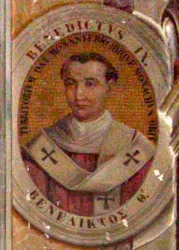
Benedict IX
- Family and early rise
- Three periods as pope
- Imperial intervention and return
- Reputation and historical significance
Benedict IX was one of the most unusual figures in the history of the medieval papacy: he held the office of pope in three separate periods during a decade of political upheaval in Rome. Born Theophylactus into the powerful Tusculan family, he became pope while still young and repeatedly lost and regained control of the city. His turbulent career exposed how Roman aristocratic rivalries and imperial intervention could shape the papacy in the eleventh century.
Family and early rise
Theophylactus was the son of Alberic III, count of Tusculum, whose family had long exercised considerable influence over Rome. His uncles had also been popes: Benedict VIII and John XIX. Their connections helped secure Theophylactus's election, usually dated to 1032. He was young, though exact details of his birth and age remain uncertain. As pope, he took the name Benedict IX.
The Tusculan family's influence was part of a wider struggle among Roman noble houses for control of civic and church offices. This meant Benedict's position depended not only on ecclesiastical authority but also on the shifting loyalties and force of local political factions.
Three periods as pope
Benedict's first pontificate lasted from 1032 until 1044. His rule was interrupted when opponents drove him from Rome during a revolt. In early 1045, a rival faction installed John, bishop of Sabina, as Sylvester III. Benedict soon returned and displaced him, restoring himself to the papal office.
In May 1045, Benedict relinquished the papacy to his godfather, the priest John Gratian, who became Pope Gregory VI. Accounts of the transaction describe a payment, and the episode was condemned as simony—the buying or selling of spiritual office. The precise circumstances and motives are difficult to reconstruct from the partisan reports of the period, but the transfer deepened the crisis over who could legitimately claim the papacy.
Imperial intervention and return
The dispute drew the attention of Henry III, king of Germany, who traveled to Italy in 1046. At the Council of Sutri in December, Gregory VI was deposed, and Sylvester III was also rejected as a claimant. Benedict, who did not appear, was condemned as well. Henry then supported the election of Clement II, beginning a period in which German rulers played a decisive role in papal appointments.
After Clement's death in 1047, Benedict returned to Rome and again claimed the papacy. His third period in office lasted from late 1047 until 1048, when Henry III's intervention helped bring it to an end. Damasus II succeeded him briefly, followed in 1049 by Leo IX, whose pontificate became associated with a major program of church reform.
Reputation and historical significance
Later writers accused Benedict of grave personal misconduct, but many of these accounts were composed in an atmosphere of reform and political conflict. Their hostile tone makes specific allegations difficult to verify. The more securely documented outline is already remarkable: Benedict's repeated returns, the contested transfer to Gregory VI, and the interventions at Sutri and Rome revealed a papacy vulnerable to aristocratic competition and secular power.
Benedict's final years are obscure. Traditions say that he eventually withdrew from public life, perhaps to a monastery, but the place and date of his death are not established with confidence. His career belongs to a turning point in papal history, as reformers sought to reduce the control of noble families and rulers over the church.