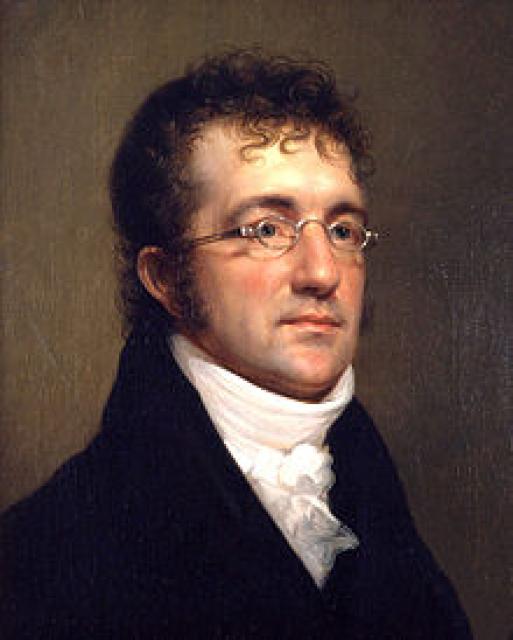
Benjamin Latrobe
 USA
USABiography of Benjamin Latrobe
Benjamin Latrobe was an American architect and engineer, born in Fulneck, Great Britain on May 1, 1764. He studied in Silesia and Saxony, and in 1786, he returned to England and began his architectural practice. According to available information, he worked under engineer J. Smeaton and architect S. Cockerell. In 1795, after the death of his wife, Latrobe traveled to the United States.
Among his early works in America were residential houses in Norfolk and Richmond, as well as the Richmond Penitentiary. In Philadelphia, where the architect moved in 1798, he designed the Pennsylvania Bank and the Philadelphia Waterworks, establishing his reputation as an architect and engineer. Among his friends were the most famous people of the time, including President Thomas Jefferson, who appointed him as the inspector of public buildings in Washington in 1803 and entrusted him with completing the reconstruction of the burned British buildings in 1814 - the U.S. Capitol.
Latrobe also designed the St. John's Church, Decatur House on Lafayette Square, and several other buildings in Washington. He worked on canal construction projects and, together with R. Fulton, built the first steamboats on the Mississippi. In 1818, he went to New Orleans to complete the construction of a waterworks started by his son in 1811 and interrupted due to his son's death in 1817.
Architectural Style and Influence
Latrobe's buildings are characterized by their original layout and exquisite proportions. They feature a combination of smooth wall surfaces and finely crafted details, with Greek motifs predominating. He first used the Ionic order to decorate the Pennsylvania Bank, making him sometimes regarded as the founder of the neoclassical style in American architecture. However, the architect was never a simple imitator of classical forms, as evidenced by his invented "corn" and "tobacco" orders for the facades of the Capitol.
His works had a significant influence on the further development of American architecture, and his students, W. Strickland and R. Mills, became leading masters of the next generation. Latrobe passed away in New Orleans on September 3, 1820.


