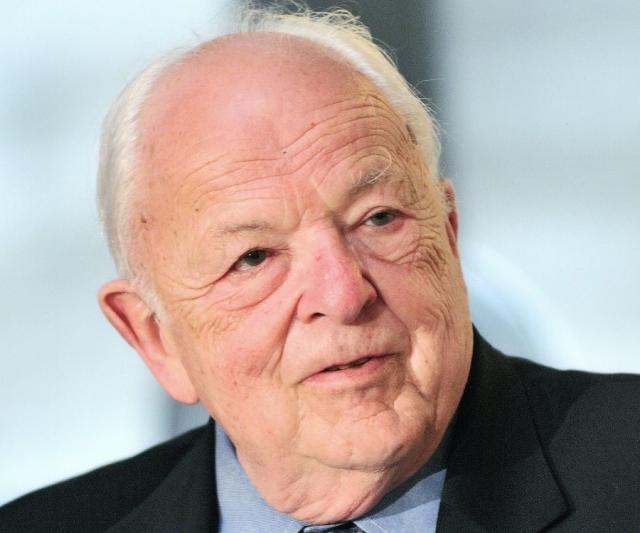
Berton Rihter
 USA
USA- Burton Richter: American Physicist and Nobel Laureate
- Graduate Studies and Early Career
- Stanford Years and Nobel Prize
- The Discovery of the J/Psi Particle
- The Charm of Quarks
Burton Richter: American Physicist and Nobel Laureate
Early Life and EducationBurton Richter was born on March 22, 1931, in New York City. As the only son and eldest of his textile worker father, Abraham Richter, and his mother, Fannie (née Pollack), Richter showed an early interest in science. He set up a chemistry lab in his basement and voraciously read books on physics.
Before attending the Massachusetts Institute of Technology (MIT) in 1948, Richter studied at Far Rockaway High School in Queens, New York, and Mercersburg Academy in Pennsylvania. Initially torn between physics and chemistry, it was Professor Francis Friedman who, in Richter's words, "opened my eyes to the beauty of physics." As a sophomore, Richter began working under Francis Bitter at MIT's Laboratory for Nuclear Science and Engineering, studying the electron-positron system. This work would form the basis of his Nobel Prize-winning research 25 years later. His senior thesis at MIT, also under Bitter's guidance, explored the effect of strong magnetic fields on the energy levels of hydrogen atoms.
Graduate Studies and Early Career
After graduating with a bachelor's degree in 1952, Richter remained at Bitter's lab as a graduate student. His initial assignment was to produce a short-lived isotope of mercury by bombarding gold atoms with high-energy deuterons. The source of these high-energy particles was a cyclotron, a type of particle accelerator. Richter soon became more interested in the workings of the cyclotron and its potential for nuclear and particle physics research than in the mercury isotope problem.
During this time, Richter met physicist David Frisch, who arranged for him to spend six months at Brookhaven National Laboratory on Long Island, New York. There, he had the opportunity to work on the Cosmotron, one of the most powerful accelerators of its time. Upon his return to MIT, Richter conducted experiments on the university's synchrotron, an accelerator similar in design to the Cosmotron but significantly smaller. In a synchrotron, accelerated particles travel in circular orbits rather than in spirals.
Stanford Years and Nobel Prize
In 1959, Richter completed his doctoral dissertation, utilizing the synchrotron to study unstable particles. After graduating, he joined Stanford University's physics faculty as an assistant professor. By this time, his interests had shifted wholeheartedly to quantum electrodynamics (QED), the theory of electromagnetic forces acting on charged particles. Richter proposed testing QED by observing collisions between moving and stationary electrons. His colleagues Wolfgang Panofsky and Sidney Drell suggested a more elegant approach: studying electron-positron pairs produced by gamma radiation. Richter's results showed that QED accurately described electromagnetic forces down to distances as small as one ten-trillionth of a centimeter.
In conventional accelerators, a beam of high-energy particles is directed at a stationary target. Significantly higher energies can be achieved by colliding two counter-rotating beams of particles. In 1957, Princeton University's Gerald K. O'Neill proposed accumulating accelerated particles in circular orbits in a vacuum chamber to produce such head-on collisions. The following year, Richter, O'Neill, and several other physicists began constructing two such storage rings at Stanford. The university's High-Energy Physics Laboratory accelerator was to feed both rings with electrons accelerated to 700 million electron volts. It took several years to overcome technical challenges before the storage rings were fully operational. The team reported their first results—a confirmation of QED, and with about 10 times better precision than Richter's earlier experiment—in 1965.
Meanwhile, Richter became an associate professor in the High-Energy Physics Laboratory in 1960. Three years later, he moved to the Stanford Linear Accelerator (SLAC), a two-mile long electron accelerator located near the university. In 1967, while continuing his work at SLAC, Richter became a full professor at Stanford University.
With the high-energy electron source provided by SLAC, physicists could design storage rings of a new type. Previous storage ring designs featured two interlocking rings in the shape of a figure-eight, with electrons circulating in separate rings and colliding at a common intersection. SLAC made it possible to produce both electrons and positrons, which could be accumulated in the same ring. The same electromagnetic fields that force electrons to circulate clockwise in a ring would force positrons to circulate counterclockwise, allowing the beams of particles and antiparticles to collide twice per revolution.
The Discovery of the J/Psi Particle
In 1980, Richter led a group that began construction of an electron-positron storage ring at SLAC. This facility, called the Stanford Positron-Electron Accelerating Ring (SPEAR), would allow collision energies of up to 8 billion electron volts. A little over a year after the facility became operational, scientific history was made.
Experiments using the new facility, which began in 1973, were the inverse of those Richter had conducted at Stanford. Whereas in those earlier experiments, electron-positron pairs were produced by high-energy electromagnetic radiation, in each collision occurring in the new facility, an electron and a positron annihilated, producing an electromagnetic "fireball" from which new particles would emerge.
In the summer of 1974, Richter's group was measuring the production rate of hadrons (a class of particles that mediate the strong nuclear force between protons and neutrons) as a function of collision energy. They would run the storage ring at a given collision energy and count the number of hadrons produced. Then, they would incrementally increase the energy and repeat the measurement. As expected, the production rate increased smoothly and gradually. However, at a particular energy corresponding roughly to three times the mass of a proton, there was a sharp, narrow peak in the hadron production rate. Such a "resonance" is often a telltale sign of a new particle with a mass corresponding to the collision energy at which the peak occurs.
Richter and his group spent several months repeating the experiment, eliminating possible sources of experimental error and measuring the hadron production rate over smaller energy increments to avoid "false alarms." By November, all potential sources of error had been ruled out, and the group announced the discovery of a particle. A day later, a group led by Samuel Ting at MIT independently and (almost) simultaneously identified the same particle using different experimental techniques. Richter named the new particle with the Greek letter ψ (psi) because "it was the only Greek letter left that had not yet been used to designate a subatomic particle." Ting chose the letter J. The two designations were later combined into J/psi.
The Charm of Quarks
The discovery of yet another new subatomic particle would not in itself have caused much stir in the high-energy physics community: over 10 hadrons had been discovered since the 1950s, and there was every reason to expect that more would be found. However, all previously known massive hadrons turned out to be unusually short-lived. They represent excited states of less massive hadrons, analogous to the excited states of atoms, which quickly decay to their less massive counterparts, such as the proton and the neutron. What was unusual about the J/psi particle was its lifetime, about 10,000 times longer than expected for a particle of its mass. This unexpectedly long lifetime suggested that the J/psi possessed some property of matter that other light particles did not.
The key to unraveling this new property was realized to be a new "flavor" of fundamental particles called charm. As early as 1963, physicists Murray Gell-Mann and George Zweig had proposed that all hadrons were composed of a few fundamental particles, which Gell-Mann called quarks. Initially, there were three types of quarks: up, down, and strange, and they could account for all the hadrons known prior to the discovery of the J/psi particle. However, in 1964, Sheldon L. Glashow and James D. Bjorken argued for the existence of



