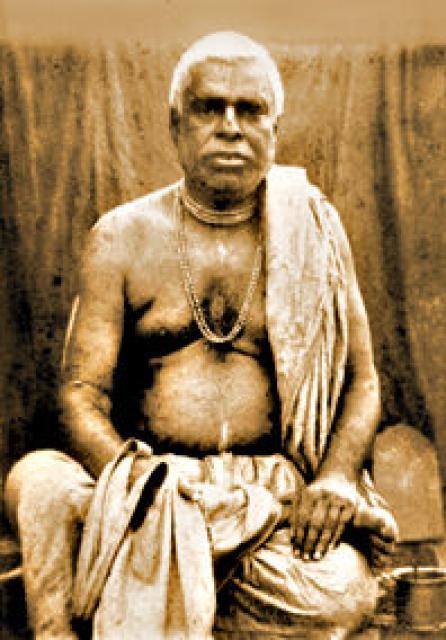
Bhativinoda Thakur
 India
India- Birth and Early Life
- Education and Visionary Grandfather
- Educator and Advocate for Ashrams
- Philosophical Lectures and Exorcism
- Literary Contributions and Revelation
- Global Reach and Recognition
- Renunciation and Spiritual Attainment
- Legacy and Significance
Birth and Early Life
Bhaktivinoda Thakur, a renowned Gaudiya Vaishnava theologian, writer, and preacher, was born as Kedarnath Datta on September 2, 1838, in the village of Birnagar, West Bengal, into a wealthy and learned family. He spent his childhood in his maternal grandfather's home in Birnagar.
Education and Visionary Grandfather
At age thirteen, Kedarnath moved to Calcutta after his father's demise. He completed his education there and received the news of his paternal grandfather's impending death soon after graduating from university. Kedarnath's grandfather, Rajavallabha Datta, was a revered figure in Calcutta. He lived as an ascetic in a secluded area of Odisha and possessed mystical abilities that enabled him to predict his death and communicate with supernatural entities. Bhaktivinoda Thakur was present at his grandfather's bedside during his final moments and received guidance from him. After his grandfather's passing, Bhaktivinoda embarked on a pilgrimage to all the major temples and ashrams in Odisha.
Educator and Advocate for Ashrams
Bhaktivinoda Thakur's subsequent career focused on education. He introduced English-language education in Odisha and authored a booklet detailing the various ashrams in the state. He actively advocated for the protection of ashrams and their role in providing shelter to wandering saints.
Philosophical Lectures and Exorcism
Bhaktivinoda Thakur later joined government service and was transferred to Bengal. His lecture on the philosophy of the "Srimad-Bhagavatam" in a town there captivated thousands. He emphasized the significance of the "Srimad-Bhagavatam" and its relevance to everyone possessing a philosophical inclination. In another town, he successfully exorcised a haunted banyan tree by having a Brahmin scholar read the "Srimad-Bhagavatam" beneath it for a month. The tree collapsed upon the completion of the reading, leaving the town relieved of its supernatural presence.
Literary Contributions and Revelation
Bhaktivinoda Thakur's literary contributions were vast. He prepared annotations for the "Vedanta-sutras" and published "Sri Krishna-samhita," which revealed the philosophy of Krishna's spiritual existence. He tirelessly sought recognition for the birthplace of Shri Chaitanya and, once successful, embarked on a fundraising campaign to construct a temple on the site.
Global Reach and Recognition
Bhaktivinoda Thakur's works, such as "Gauranga-smarana-mangala-stotra," introduced the teachings of Shri Chaitanya to Western philosophers and scholars. His annotations on the "Brahma-samhita" and "Krishna-karnamrita" further solidified his status as a renowned theologian. He founded the magazine "Sajjana-toshani," which became a leading publication on spiritual matters.
Renunciation and Spiritual Attainment
In his later years, Bhaktivinoda Thakur renounced worldly life and received initiation from Gaura Kishora das Babaji. Despite his ascetic lifestyle, he continued to guide and bless countless individuals. In 1910, he entered a state of complete samadhi, concentrating solely on Krishna's eternal pastimes. He departed from this world on the anniversary of Gadadhara's disappearance in 1914.
Legacy and Significance
Bhaktivinoda Thakur is regarded as a saintly acharya within the Gaudiya Vaishnava tradition of Hinduism. His literary contributions, philosophical insights, and dedication to disseminating the teachings of Shri Chaitanya established him as a pioneering figure in the globalization of Vaishnava thought.