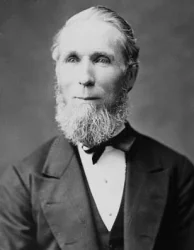
Bill Hewlett
- A Stanford Friendship
- The First HP Product
- Wartime Service and Return to HP
- The HP Way
- Family and Philanthropy
- Later Years and Legacy
William R. “Bill” Hewlett helped build Hewlett-Packard from a small partnership in a Palo Alto garage into one of the defining technology companies of the twentieth century. An engineer by training, he designed the audio oscillator that became the company’s first product. He later guided HP through decades of growth while helping shape its informal, engineering-centered workplace culture. His influence also extended through philanthropy in education, health, science, and public policy.
A Stanford Friendship
Hewlett was born on 20 May 1913 in Ann Arbor, Michigan, where his father taught medicine. The family later moved west, and Hewlett attended Stanford University, earning a bachelor’s degree in 1934. He continued his electrical engineering studies, receiving a master’s degree from the Massachusetts Institute of Technology in 1936 and an engineering degree from Stanford in 1939.
At Stanford, Hewlett met David Packard. The two shared an interest in engineering and the outdoors, and their friendship became the foundation of a business partnership. Hewlett developed an audio oscillator design while a graduate student; Packard brought complementary engineering and business skills. Their collaboration began with a modest investment and a rented garage in Palo Alto.
The First HP Product
Hewlett and Packard formally established their company in 1939. Their first successful product was the HP 200A, a resistance-capacitance audio oscillator used to test sound equipment. Hewlett solved a stability problem in the circuit with a small light bulb, producing an instrument that was reliable and significantly less expensive than competing devices.
The product brought an early breakthrough. Walt Disney Studios ordered eight modified oscillators to test audio equipment for Fantasia, the animated feature whose experimental sound system became a technical landmark. The contract gave the young company a prominent customer and helped prove that engineering innovation could be paired with affordability.
The company’s early years were not limited to one device. Hewlett and Packard took on a range of small engineering jobs while developing test and measurement equipment. Their emphasis on practical problem-solving and close contact with engineers became central to HP’s identity as it grew.
Wartime Service and Return to HP
During World War II, Hewlett served as an Army officer. He worked first in ordnance and later in the Signal Corps and the War Department’s New Development Division, applying his technical training to military electronics. He was sent to the Philippines and Japan near the end of the war and returned to California in 1945.
By then, HP had grown well beyond its garage beginnings. Hewlett became vice president in 1947 and moved through increasingly senior positions. He became executive vice president in 1957, president in 1964, and chief executive officer in 1969. He served in company leadership until retiring as CEO in 1978, then remained chairman of the executive committee and later vice chairman of the board.
The HP Way
Hewlett’s management style helped shape what became known as the HP Way. He encouraged engineers to take initiative, gave employees room to solve problems, and made regular informal visits to laboratories and offices—a practice often described as “management by walking around.” He and Packard valued candid discussion and responsibility close to the work itself. As HP expanded into instruments, computers, calculators, and other technology, this culture became part of the company’s public identity.
Hewlett was not simply a symbol of the company’s culture; he remained active in engineering and management for decades. He also contributed to the wider electronics industry, including through leadership in professional organizations. In 1985, he received the National Medal of Science for his contributions to engineering and technology.
Family and Philanthropy
Hewlett married Flora Lamson, a biochemist, in 1939. They had five children. The couple shared a strong interest in public service and established the William and Flora Hewlett Foundation in 1966. The foundation supported education, health, scientific research, and other public causes, later becoming one of the largest private philanthropies in the United States.
After Flora’s death, Hewlett married Rosemary Bradford. He also supported research and educational institutions, serving as a trustee of Stanford and other organizations. His interests outside work included climbing, skiing, fishing, botany, and ranching.
Later Years and Legacy
Hewlett stepped back from HP’s day-to-day leadership in the late 1970s but remained connected to the company and to philanthropic work. He died in Palo Alto on 12 January 2001, aged 87.
His legacy rests on both invention and institution-building. The 200A oscillator established HP’s first product line, while his decades of leadership helped the company become a major force in electronics and computing. The management culture he and Packard developed influenced generations of technology firms, and the foundation he created with Flora continues to fund work in education, health, the environment, and public policy.