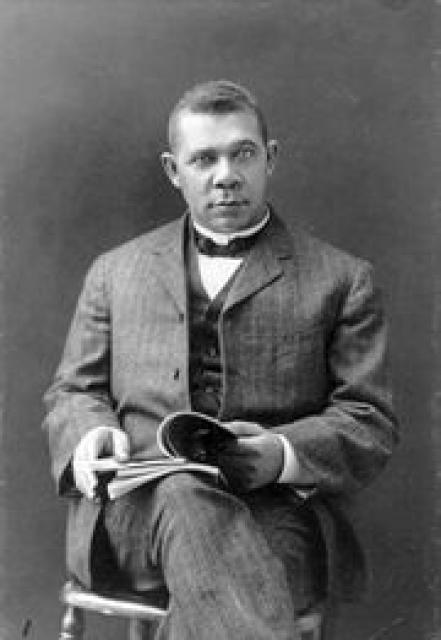
Booker Washington
 USA
USABiography of Booker Washington
Booker Washington was an American educator, orator, politician, and writer. He was one of the most prominent advocates for the education and enlightenment of African Americans. Born on April 5, 1856, on a plantation in Virginia, Washington was the son of a black slave woman and an unknown white man. His mother worked as a cook in the plantation owner's house, preparing meals for the family.
After the Civil War, which ended slavery in the United States, Washington's mother left the plantation and moved with her children to Malden, West Virginia. There, Booker taught himself to read and later attended a Sunday school for black children. He worked in the mornings before school to support his family by shoveling coal. He also worked in a salt factory and coal mines while continuing to educate himself.
At the age of seventeen, in 1872, Washington enrolled in the Hampton Normal and Agricultural Institute for African American students in Virginia. After completing his studies, he became a teacher in black schools in the South and even worked briefly as the secretary to General Samuel Armstrong, the principal of the Hampton Institute. Washington later moved to Washington, D.C., where he continued his education. In 1879, he earned a teaching degree and began teaching at the Hampton Institute, which admitted its first group of Native American students.
Washington authored several books, with his most famous work being "Up from Slavery." He was a remarkable orator and a prominent advocate for the education and enlightenment of African Americans. In September 1895, at the opening of the Atlanta Exposition, he delivered a speech outlining his social and political beliefs, emphasizing racial and class harmony and close cooperation between white and African American populations. He became the first black person in American history to address a predominantly white audience.
In his speech, Washington advocated for equality in two areas: employment opportunities and entrepreneurship. His ten-minute speech shaped racial politics in the South and established Booker Washington as a leader of the African American community. His public speaking engagements soon began to generate financial support for the Tuskegee Institute.
President Theodore Roosevelt sought Washington's advice regarding appointments to government positions for both black and white people from the South. In 1896, Washington embarked on a trip to Europe, visiting Antwerp, The Hague, Paris, and London. During his travels, he met Mark Twain and was received by Queen Victoria. Upon his return to the United States, Washington emerged as a recognized leader of the African American community, advocating for a peaceful resolution to the racial problem.
General Armstrong recommended Washington as the organizer of the educational process in the newly opened Tuskegee Normal and Industrial Institute for African Americans in Alabama. In 1881, Washington became the director of the institute for black students in Tuskegee. The institute provided secondary education with a focus on industrial skills.
The institute faced a severe lack of resources, and there was not enough money to acquire sufficient land or construct adequate buildings. When students gathered in Tuskegee at the beginning of the first academic year, they had to attend lectures on the floor of a dilapidated old church.
In Tuskegee, Washington created an environment for his students to receive a proper education while also teaching himself. He expanded the institute's educational base and introduced the study of agriculture and trades. Year after year, he traveled around the country, collecting funds for his institute, sometimes in a small carriage and other times on a mule, constantly seeking support. The level of his institution was such that people from Europe, China, and Japan came to learn and adopt the Tuskegee experience, especially in agricultural education.
During Washington's lifetime, the Tuskegee Institute continued to grow and develop. The university complex and student campus consisted of over one hundred new buildings, and the number of students reached 1600.
The Tuskegee Institute stands as a testament to Booker Washington's legacy.
Quotes and Aphorisms:
- "Great people cultivate love within themselves, while petty souls nurture a spirit of hatred."
- "No person who contributes to the material, intellectual, and moral well-being of the society in which they live will ever remain unrewarded for long."
- "There are two ways to exert force: pushing down and pulling up."
- "When we interact with others, we either help or hinder them. There is no middle ground: we either drag them down or lift them up."
- "It is easy to push down a weak person who is trying to rise; it requires little intelligence, generosity, or organizational skills. Anyone can do it. True greatness, generosity, and statesmanship are demonstrated by constantly encouraging everyone to become the most useful, intelligent, and patriotic citizen."
- "The cradle of personal success in life lies in maintaining friendship, trust, and respect from your immediate neighbors."
- "I have learned that success should be measured not by the position one reaches in life but by the obstacles one overcomes while striving for success."
- "To the extent that a person devotes themselves to a great cause, they will find the greatest happiness in their work."
- "The highest criterion of civilization for any race is its willingness to extend a helping hand to less fortunate peoples."
- "If you want to rise, help someone else rise."
- "A life worthy of its name is one dedicated to the well-being of others."
- "I believe that every person's life should be filled with constant and unexpected stimuli that push them to perform at the highest level every day."