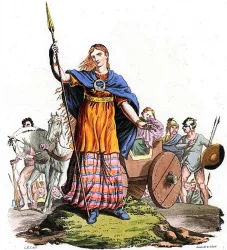
Boudica
Queen of the Iceni
Boudica was the queen of the Iceni, a people of eastern Britain whose lands lay largely in what is now Norfolk and surrounding areas. The exact dates of her birth and early life are unknown. She was married to Prasutagus, the Iceni king, whose community maintained a degree of local autonomy under Roman rule.
When Prasutagus died around 60 CE, he left his kingdom jointly to his daughters and the Roman emperor, apparently hoping to preserve his family’s position. Roman officials instead annexed Iceni territory. The ancient historian Tacitus reports that Boudica was flogged and her daughters assaulted. These accounts were written by Roman authors, and details cannot be independently confirmed, but they describe the violence and political humiliation that helped ignite the revolt.
Rebellion against Rome
In 60 or 61 CE, while the Roman governor Suetonius Paulinus was campaigning in Wales, Boudica led the Iceni in an uprising. The Trinovantes and other communities joined the rebellion, which rapidly became one of the most serious challenges to Roman control of Britain.
The rebels first attacked Camulodunum, the Roman colony at modern Colchester, then advanced on Londinium and Verulamium, now London and St Albans. The three settlements were destroyed, and many inhabitants were killed. Roman forces were stretched thin, and the revolt caused a major crisis for the provincial government.
Suetonius eventually regrouped his troops and confronted the Britons at a location that remains uncertain. The Roman army won despite being heavily outnumbered, according to Tacitus. The revolt collapsed, and Roman authority over the province was reasserted. Ancient sources differ on Boudica’s fate; Tacitus says she died after the defeat, while Cassius Dio gives another account.
A lasting symbol
Because Roman writers provide the main surviving accounts, Boudica’s own voice and motives are lost. Their narratives portray her as both a determined leader and an emblem of rebellion against occupation. Later generations in Britain transformed her into a national symbol of resistance and courage, especially during periods when the idea of resisting foreign rule held political force.
Boudica’s revolt came close to overturning Rome’s control of its newest province. Her story remains a reminder of the violence of conquest and the ability of local communities to organize against imperial power.