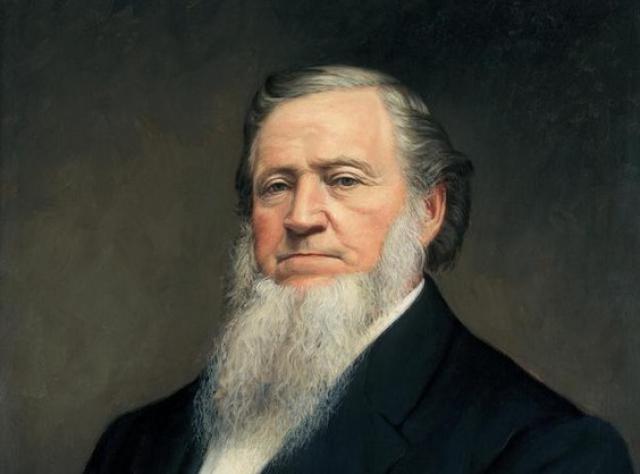
Bringham Young
 USA
USA- Early Life and Education
- Joining the Mormon Faith
- Rise in the Mormon Church
- Presidency of the Church
- Exodus to Utah
- Statehood and Conflict
- Mountain Meadows Massacre
- Polygamy
- Legacy in Literature
Early Life and Education
Brigham Young was born on June 1, 1801, as the ninth of eleven children to John and Abigail Howe Young in Whitingham, Vermont. Growing up in the remote forests of central New York, the young Brigham lacked formal education but excelled in backbreaking labor.
Joining the Mormon Faith
In 1832, after reading the Book of Mormon, Brigham Young was deeply moved by the Mormon teachings and joined the faith. He became an active missionary and in 1833 moved to Kirtland, Ohio, to join other believers.
Rise in the Mormon Church
Young's devotion to the Mormon faith was unwavering. In 1835, he became one of the original members of the Quorum of the Twelve Apostles. Despite persecution and the loss of property in Missouri in the 1830s, he remained steadfast. In 1840, he embarked on a mission to England, successfully converting many who later relocated to join Mormon communities in the United States.
Presidency of the Church
Following the assassination of Joseph Smith in 1844, Young played a pivotal role in convincing the Mormon community that authority should pass to the apostles. He became the second president of the Church of Jesus Christ of Latter-day Saints in 1844.
Exodus to Utah
In 1846-1847, Young led his followers out of Illinois and into Utah Territory (then Mexican territory), where he oversaw the establishment of Salt Lake City. He also directed the creation of over 350 communities and settlements throughout Idaho, Nevada, California, and Arizona, attracting around 50,000 settlers from the Midwest and European immigrants.
Statehood and Conflict
In 1849, Young presided over the unrecognized State of Deseret. As governor of Utah Territory from 1851-1858, he managed both ecclesiastical and civil affairs. The Mormons' desire for independence and disregard for federal authority led to a conflict with the U.S. government. In 1857, President Buchanan appointed a non-Mormon governor, triggering the Utah War. Young initially planned to burn Salt Lake City and flee to Mexico but eventually agreed to step down as governor and received a presidential pardon.
Mountain Meadows Massacre
During the Utah War, a tragic event occurred known as the Mountain Meadows Massacre. In 1857, 120 peaceful settlers traveling from Arkansas to California were slaughtered, including women and children. One of Young's associates, John D. Lee, was convicted for his role in the massacre.
Polygamy
Brigham Young was a polygamist, married to 55 women and fathering 57 children. To accommodate his large family, he constructed the Lion House in Salt Lake City, with separate apartments for each wife.
Legacy in Literature
Brigham Young has been a prominent figure in literature. In Arthur Conan Doyle's "A Study in Scarlet," he is depicted as an authoritarian and fearsome leader. In Mark Twain's "Roughing It," Young is portrayed as the de facto ruler of Utah Territory, overshadowing the nominal federal authorities. David Ebershoff's "The 19th Wife" also includes Young as a significant character.