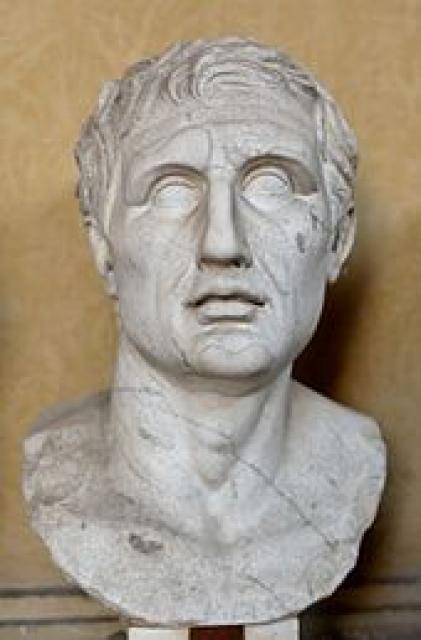
Caecilius Statius
- Cecilius Statius
- Early Life and Career
- Recognition and Influence
- Adaptation of Greek Originals
- Fragments and Legacy
Cecilius Statius
Cecilius Statius was a prominent Roman comic poet who hailed from Gallia.
Early Life and Career
Statius was born in the Insubrian territory of Gaul, likely in Mediolanum, around 200 BC. He was possibly taken as a captive to Rome during the Roman-Gallic wars. Initially a slave, he adopted the name Cecilius from his patron, likely a member of the Metelli family.
To earn a living, Statius adapted Greek plays from New Comedy authors, primarily Menander, for the Roman stage. This genre was known as Comoedia palliata. His exceptional delivery earned him the honor of performing Terence's Andria in 166 BC.
Recognition and Influence
Statius's success earned him high praise. The critic Volcacius Sedigitus ranked him first among comic poets, while Varro admired his pathos and skill in plot construction. Horace acknowledged his merits, though he contrasted him with Terence's artistry.
Quintilian expressed mild disapproval, and Cicero considered Statius the greatest comic poet, despite his foreign origin. The popularity of Statius's plays is evident from the fact that they were simply referred to by name, without the author's identification.
Adaptation of Greek Originals
Statius's approach to adapting Greek plays fell between those of Plautus and Terence. He did not blend Greek and Roman elements like Plautus, nor did he eliminate all non-Romanized features like Terence.
Fragments and Legacy
Only fragments of Statius's plays survive, primarily preserved by Aulus Gellius. These fragments allow for a comparison between Roman comedy and its Greek model, highlighting Statius's diffuse and less faithful translation style compared to Plautus's Bacchides.
Despite the fragmentary nature of his work, Cecilius Statius remains an important figure in the history of Roman comedy, influencing later playwrights and contributing to the development of Roman theater.




