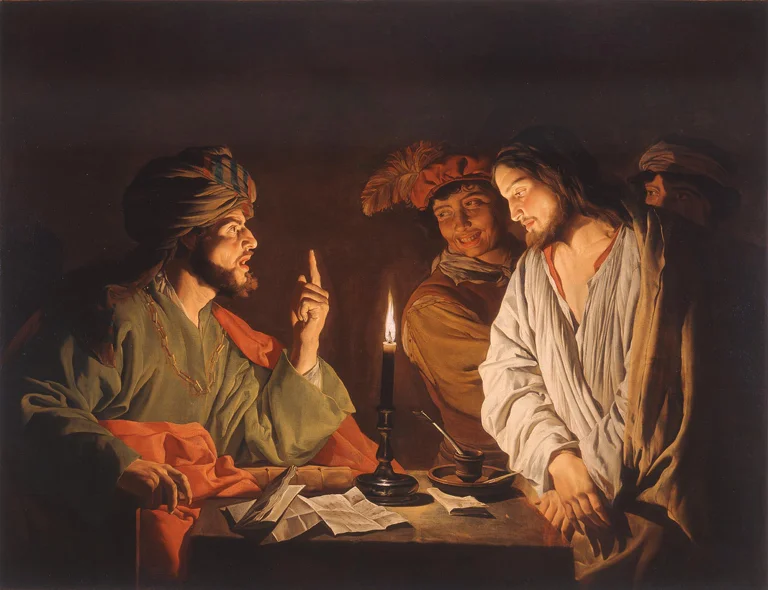
Caiaphas
Caiaphas, known in the historian Josephus as Joseph who was called Caiaphas, served as high priest in Roman Judea from about 18 to 36 CE. His unusually long tenure spanned the governorship of Pontius Pilate and the public activity of Jesus of Nazareth. He appears in the Gospel accounts of Jesus’s arrest and trial, while the historical record gives only a limited view of his wider life and leadership.
High Priest Under Roman Rule
The Roman prefect Valerius Gratus appointed Caiaphas to the high priesthood around 18 CE. Rome controlled the appointment and removal of high priests, making the office both a religious leadership role and a position shaped by imperial politics. Caiaphas was the son-in-law of Annas, a former high priest whose family continued to wield influence. His long service suggests that he maintained a working relationship with the Roman authorities through a period when other high priests were more frequently replaced.
As high priest, Caiaphas stood at the head of the Jerusalem Temple establishment, responsible for its rites and administration. Judea’s political environment was tense: Roman rule relied on local elites, while religious authorities navigated competing expectations among the population and the occupying power. The surviving sources do not offer a detailed account of his policies or personal views.
Gospel Accounts and Historical Evidence
The New Testament Gospels describe Caiaphas as a leading figure in the proceedings against Jesus before his transfer to the Roman authorities. These narratives were written from a Christian perspective and differ in their presentation of the events. Josephus independently confirms that a high priest named Joseph, called Caiaphas, held office during this period, but does not provide a parallel account of the trial. Historical descriptions therefore distinguish the secure outline of his tenure from details preserved in religious texts.
An ornate first-century ossuary discovered in Jerusalem bears an Aramaic inscription commonly read as “Yehosef bar Qayafa,” or Joseph son of Caiaphas. It has often been associated with the high priest’s family, and may have contained the remains of the high priest himself, though the identification is not certain. The find offers a glimpse of the burial practices and social standing of a priestly household in Jerusalem.
Deposition and Legacy
In 36 CE, the Roman governor of Syria, Vitellius, removed Caiaphas from office, shortly after Pilate was recalled. Caiaphas disappears from the historical record thereafter. His historical reputation has been shaped largely by his role in Christian accounts of the Passion, a portrayal that can obscure the political constraints under which a Judean high priest served.
The combination of Josephus’s testimony, the Gospel narratives, and archaeological evidence places Caiaphas firmly within the religious leadership of first-century Jerusalem. Beyond that outline, much about his character, decisions, and final years remains unknown.