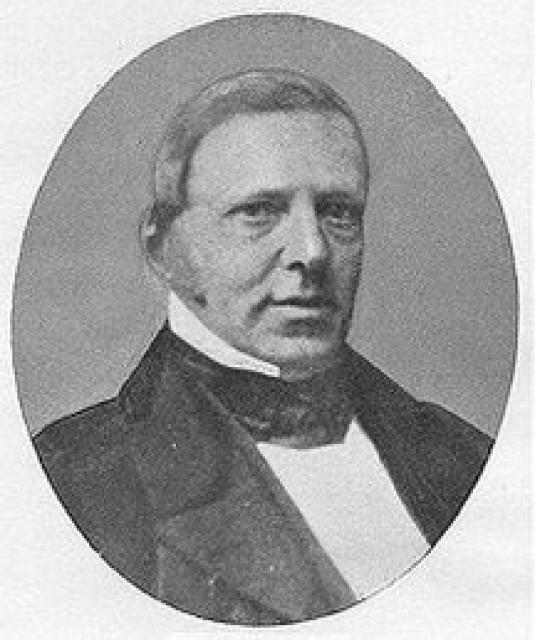
Carel-Gabriel Cobet
 Netherlands
Carel Gabriel Cobet was a Dutch classical scholar whose close reading of Greek texts made him one of the leading philologists of nineteenth-century Europe. Based at Leiden University for most of his career, he worked to restore ancient writings by comparing manuscript evidence, language and literary usage. His sharp instinct for Greek prose, sometimes paired with bold conjectures, influenced generations of Dutch classicists and helped establish Leiden as a major center of classical scholarship.
From Paris to Leiden
Cobet was born in Paris on 28 November 1813 to Dutch parents working in France. The family returned to the Netherlands when he was an infant, and he grew up in Dutch academic life. He entered Leiden University in 1832 as a theology student, but his interest soon shifted to classical philology. He spent long hours reading Greek and Latin works in the university library, where the librarian Johan Jacob Geel helped shape his scholarly interests.
In 1835, Cobet won the university’s gold medal for Prosopographia Xenophontea, a study of the people mentioned in the writings of Xenophon. He completed his doctorate in 1840 with a dissertation on fragments of the comic poet Plato. The work helped introduce him to Leiden’s established classicists and launched a career devoted to the close study of ancient texts.
Manuscripts and Greek Texts
After his doctorate, Cobet travelled and studied in France and Italy for five years. He examined Greek manuscripts in Italian libraries and developed a detailed knowledge of the habits of copyists and the history of texts. This experience became central to his method: instead of accepting a received reading automatically, he weighed how a passage might have changed during transmission and whether an alternative reading better fit Greek grammar and style.
Cobet’s publications included Commentationes philologicae, Variae Lectiones and Novae Lectiones, collections of notes and proposed corrections on Greek authors. He worked across a broad range of Greek prose, including texts by Xenophon, Euripides, Diogenes Laertius and Lysias. His method trusted close attention to Greek usage and the idea that a writer’s expression could often be restored through careful linguistic reasoning. Some conjectures became part of later scholarship; others were debated as overly confident. His work remains a reminder that textual criticism depends both on evidence and on the judgment used to interpret it.
A Teacher and University Leader
Cobet was appointed professor at Leiden in 1846 and became a full professor in 1849. He taught Greek and classical literature for decades, serving as rector of the university in 1863–64. His students went on to hold chairs at other Dutch universities, spreading a Leiden style of philology grounded in linguistic detail and the close reading of primary sources.
In 1856, Cobet became a founding editor of Mnemosyne, a journal devoted to classical studies. The publication gave scholars a venue for discussing ancient literature and textual problems, and it grew into one of the field’s leading journals. Through his teaching, editorial work and research, Cobet helped shape the next generation of Dutch classical scholarship. He retired from his professorship in 1884.
Legacy
Cobet died in Leiden in 1889. His reputation rested on a rare command of Greek, an intimate knowledge of manuscripts and a willingness to challenge transmitted texts. Later scholars sometimes questioned the consistency of his method, but the strongest of his readings continued to influence editions and debate. More broadly, he helped make textual criticism a central part of classical philology in the Netherlands. His name remains associated with an approach that treated ancient literature not as a fixed artifact, but as a text whose history could be traced through the careful study of language and manuscripts.


