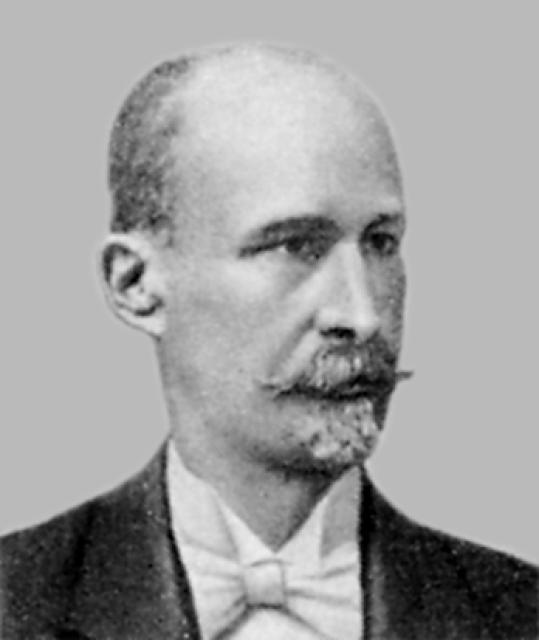
Emil Kaluzniacki
 Poland
- Polish-Russian Slavist and Philologist
- Contributions to Slavic Studies
- - "Moldavian and Multan Documents from Lviv City Archives" (1878)
- - "On the Question of Old Slavic Secret Writing" (1883)
- The Puten Gospel Edition
Polish-Russian Slavist and Philologist
Early Life and Academic CareerŁawrenty Silwestrowicz Kałużniacki was a prominent Polish-Russian Slavist and philologist. He served as a member of the Imperial St. Petersburg Academy of Sciences and taught at a gymnasium in Rzeszów before becoming a professor of Slavic philology at Chernivtsi University.
Contributions to Slavic Studies
Kałużniacki made significant contributions to the field of Slavic studies. He published numerous articles in Jageljski's "Archiv für slavische Philologie" and authored several influential works:
- "Review of Slavic-Russian Monuments of Language and Writing Held in Lviv Libraries" (1877)
- "Moldavian and Multan Documents from Lviv City Archives" (1878)
- "Historical Overview of the Graphics and Orthography of the Polish Language" (1882)
- "On the Question of Old Slavic Secret Writing" (1883)
- "The Life of Moses the Hungarian, Written by the Kyiv-Pechersk Monk Polycarp" (1884)
- "Contributions to the Bibliography of Church Slavonic Printed Editions in Russia" (1886)
- "Hegumen Naftanail's Book on Faith: Its Sources and Significance in the History of Southern Russian Polemical Literature" (1886)
The Puten Gospel Edition
Kałużniacki's most notable work was his edition of the Puten Gospel, an apronak preserved in the Basilian monastery in Putna, Bukovina. Based on paleographic evidence, he dated the gospel to the late 13th or early 14th century.
The Puten Gospel is particularly noteworthy for its clear traces of the Ukrainian language. In an extensive Latin introduction, Kałużniacki commented on the relationship between Ukrainian and Russian languages, denying the former's status as an independent language.