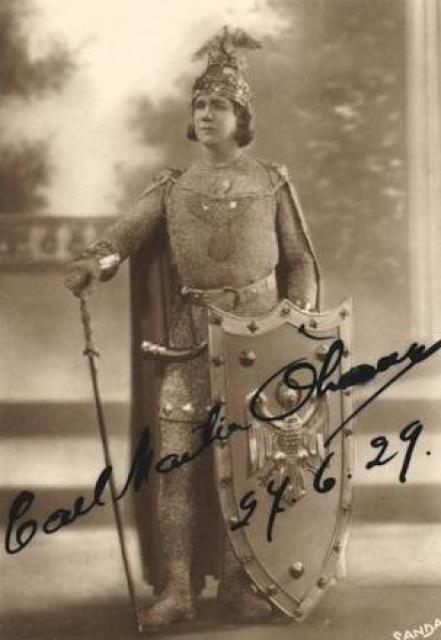
Carl Martin Oehman
 Sweden
Biography of Karl Martin Eman
Karl Martin Eman was a Swedish tenor who achieved international recognition in 1924 at the Metropolitan Opera in New York City. He was born in 1887 in Floda, Sweden, the son of a Lutheran pastor. Initially, Eman served as an officer in the Swedish army before transitioning to music theory and piano and organ playing at the Royal Conservatory in Stockholm in 1907. He was trained by Carl Gentzel in Stockholm and Oxilia and Quadri in Milan. Eman made his debut as a concert singer in 1914 and performed in various operas, including Daniel Auber's "Fra Diavolo" at the Stora Theatre in Goteborg.
In 1919, Eman began working with the Royal Opera in Stockholm and remained a member for over 20 years until 1944. He gained international recognition in 1924 at the Metropolitan Opera, where he played his first American role in Leos Janacek's "Jenufa." Eman also appeared as Samson at the Metropolitan Opera but did not reprise the role again for unknown reasons. He performed at the Vienna State Opera and signed a contract with the Städtisches Opernhaus Berlin, where he remained one of the most popular singers in the ensemble until 1937. His repertoire included lyrical Wagnerian roles and roles in operas by Giuseppe Verdi, such as "Don Carlos" and "Simon Boccanegra."
Notable moments in Eman's career include his performances as Lohengrin at the Zoppot Festival in 1926, as well as his portrayal of Stolzing in "Die Meistersinger von Nürnberg" and Siegmund in "Die Walküre" in 1929. He also performed in Covent Garden in London in 1927, singing the roles of Tannhäuser and Stolzing.
In the early 1930s, Eman limited his performances to Berlin and Stockholm. He made his last appearance at the Vienna State Opera in 1934 and retired from the stage in 1937. However, he continued to perform as a concert singer until 1940. Eman gained immense popularity for his portrayal of the Chinese prince Sou-Chong in Franz Lehár's "Das Land des Lächelns," and toured with the opera, made radio appearances, and recorded the role. He performed Sou-Chong over 700 times throughout his career.
Eman received the "Litteris et Artibus" medal from the Swedish royal court in 1927 and was named the "Singer of the Swedish Royal Court" in 1933. He also worked as a singing teacher and had notable students such as Finnish operatic bass Martti Talvela and Swedish tenor Nicolai Gedda. In his later years, at the age of 56, Eman participated in a symphony-cantata performance of Gustav Mahler's "Das Lied von der Erde" with the Concertgebouworkest conducted by Carl Schuricht. This project was recorded, including a memorable incident where a woman in the audience shouted "Germany above all, Mr. Schuricht!" right before the final movement, causing annoyance among other audience members. Eman possessed a beautiful "Nordic" voice and had excellent control and expressiveness.