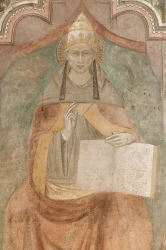
Celestine V
Celestine V became pope after a two-year deadlock among the cardinals, an extraordinary choice for a man who had spent much of his life as a hermit. His brief pontificate ended with an even rarer act: he resigned the papacy. Remembered as a saint and founder of a monastic order, he remains one of the most unusual figures to have occupied the medieval papal throne.
A Hermit in the Mountains
Born Pietro Angelerio around 1215 in southern Italy, he entered a Benedictine monastery as a young man. He later withdrew into the mountains of the Abruzzo, where he lived an ascetic life in caves and remote hermitages. His reputation for holiness attracted followers, and the communities that grew around him eventually formed the Celestine congregation, a branch of the Benedictine tradition.
Pietro founded the monastery of Santa Maria di Collemaggio near L’Aquila, which became an important center for his followers. His life was far from the political world of Rome, but the growing renown of the hermit made him a candidate when the papacy entered a prolonged crisis.
An Unexpected Election
After Pope Nicholas IV died in 1292, the cardinals failed for more than two years to agree on a successor. In July 1294, they elected Pietro, who took the name Celestine V. He was consecrated and crowned at L’Aquila in August. His election was widely seen as a spiritual answer to the deadlock, but it also created immediate challenges: the new pope had little experience in the administration and diplomacy expected of the office.
Celestine reintroduced rules requiring cardinals to meet in a conclave to elect a pope. He also appointed new cardinals and established his court in Naples, where he relied heavily on King Charles II. The arrangement raised concerns that the monarch had too much influence over papal decisions. Celestine’s own contemplative nature made the demands of government increasingly difficult.
Resignation and Captivity
On 13 December 1294, Celestine announced that he was resigning. He had first clarified that a pope could abdicate, then formally relinquished the office before the cardinals. The resignation was accepted, and the cardinals elected Cardinal Benedetto Caetani as Boniface VIII.
Celestine hoped to return to a life of prayer, but his successor feared that opponents might use the former pope’s reputation to challenge the new pontificate. Boniface placed him under guard. Celestine was eventually held at the castle of Fumone, where he died on 19 May 1296. Accounts of his final years emphasize his continued devotion, though the circumstances have also invited speculation about the harshness of his confinement.
A Lasting Example
Celestine’s resignation became a landmark in the history of the papacy. It showed that the office could be voluntarily relinquished and later served as a precedent for other discussions of papal resignation. The Catholic Church canonized him in 1313, less than two decades after his death.
His legacy is defined by the contrast between his solitary spirituality and the political demands of papal leadership. Celestine V entered history as a pope who could not remain in office, but also as a reforming monk whose renunciation became an enduring example of conscience and humility.