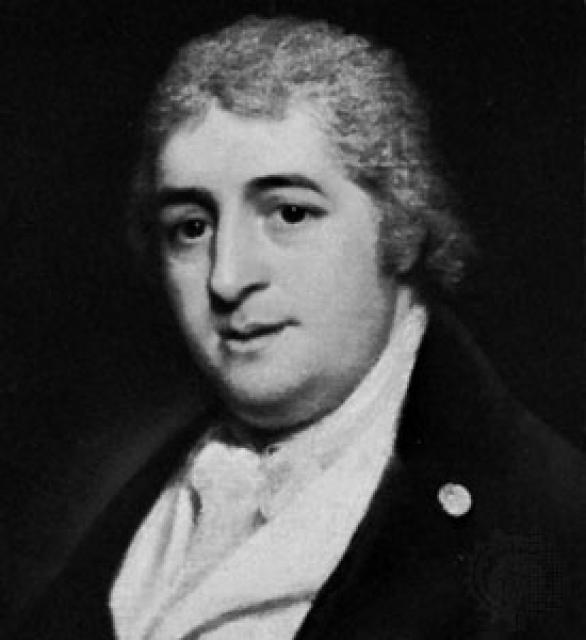
Charles Dibdin
 Great Britain
Biography of Charles Dibdin
Charles Dibdin was an English singer and composer who possessed both business acumen and creative talent. He was born on March 4, 1745, in the town of Southampton, England, as the eighteenth child in his family. His father, a modest church worker, could not provide him with a proper musical education, so the talented child had to pave his own way in music. Dibdin's musical abilities first emerged at the age of nine when he enrolled in Winchester College. The organist noticed his talent and gave him a few lessons in musical craftsmanship. These lessons became Dibdin's only formal education in music.

After receiving a few lessons, Dibdin began singing in churches and concerts. However, he decided to pursue a career as an organist in a church, but his audaciousness was not well-received, and he was not hired. Fortunately, his older brother Tom returned from a sea voyage at that time. Tom, who was almost thirty years older than Charles, took the young man to London and found him work as a harpsichord tuner. Dibdin started composing pieces for harpsichords, but without his brother's support, no one wanted to publish them. As a result, Dibdin sold his first six ballads for a pittance to a church music publisher.

Dibdin's life was filled with ups and downs. One of the fortunate turns of events was his acquaintance with the manager of the prestigious Covent Garden Theatre, who arranged for him to join the choir as a singer. In the theatre, the talented young man quickly caught the attention of others, and at the age of seventeen, he composed the ballad "The Shepherd's Artifice". For some time after that, he wrote and performed ballads, becoming a successful singer. However, Dibdin decided to focus on improving his talent as a composer and temporarily withdrew from performing. He returned to the stage later, but only performed his own compositions.
In 1767, when Dibdin was just 22 years old, he produced his first opera, titled "Love in the City". Although the staging of the opera failed, the music received the highest praise from critics. Sensibly, Dibdin decided to promote his own name. In 1768, he produced the opera "The Padlock", in which he served as composer, producer, and performer of one of the roles. This opera was a tremendous success, leading Dibdin to produce numerous other performances. In 1778, he became the exclusive composer of Covent Garden Theatre, but his high status did not last long.
Dibdin's love affairs caused a scandal related to his extramarital relationship, leading to his expulsion from the theatre. Despite having a lawful wife, he was involved with one of the choristers who bore him several children. Interestingly, two sons from this relationship became renowned playwrights. In 18th century England, such scandals were severely punished, while nowadays an artist's scandalous romance can increase box office revenue. Dibdin left Covent Garden and began working at the Circus Theatre. However, due to personal conflicts with the theatre staff, he left in 1785.
From that point, Dibdin faced significant financial difficulties. He attempted to establish his own theatre, but it was destroyed by a hurricane. He wrote a couple of plays that flopped. Then, Dibdin decided to travel to India, where his brother Tom had perished during a trading expedition. To raise money for the journey, he embarked on a tour across England. Unfortunately, the tour was unsuccessful because, by that time, Dibdin had become such a prominent figure in his country that people did not believe he could personally visit the provinces, considering the performer a fraud. Left bankrupt, Dibdin decided to sell the rights to his works, again for very little money. However, in 1788, he finally set sail for India, but his ship wrecked near Torbay, a small town in southwest England.
Penniless and homeless, Dibdin organized another tour in the provinces. This time, people believed him, and his performances were incredibly successful. Inspired by his triumph, Dibdin returned to London and organized a series of sold-out performances. Within four months, he earned more money than he had in his entire life. With this money, Dibdin opened the San Susi Theatre, which was not successful. He attempted to give lectures and write books but was unsuccessful since he still lacked proper education, and no one wanted to read the amateurish musings. In 1803, he received a personal pension of 200 pounds per year from the government and retired. However, in 1808, his pension was revoked, and he had to work again. Without the same zeal and spark, he failed to replicate his previous success.
In 1813, Dibdin suffered a stroke, and he passed away a year later in 1814. Dibdin was married twice, and he had children from both his wives and mistresses. Unfortunately, to the maestro's great sorrow, he outlived almost all of his children, with the exception of one daughter. In the history of music, Charles Dibdin is known as one of the best composers of sea songs. Although he never went on long voyages himself, Dibdin admired the courage and bravery of sailors who, as he believed, were awaited on the shore by beautiful ladies and were willing to give their lives for the interests of their country.