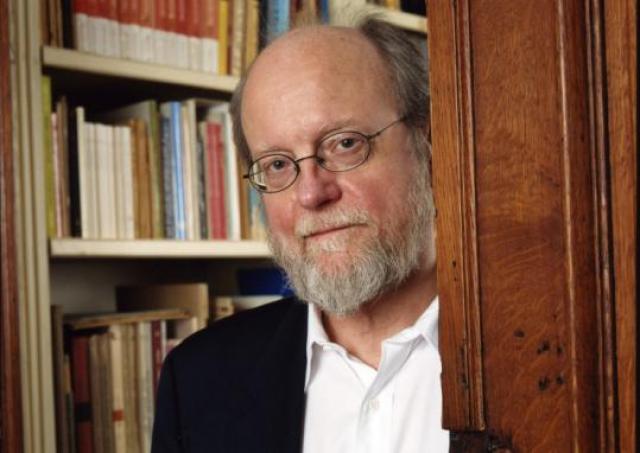
Charles Peter Wuorinen
 USA
USA- Early Life and Education
- Musical Beginnings
- The Group for Contemporary Music
- Pulitzer Prize and Subsequent Acclaim
- Choral Masterpieces and MacArthur Fellowship
- Vocal Works and Opera
- Conclusion
Early Life and Education
Charles Wuorinen was born on June 9, 1938, on the Upper West Side of Manhattan, New York City. His father, John H. Wuorinen, was a renowned historian of Scandinavia who taught at Columbia University. His mother, Alfhild Kalijarvi, held a master's degree in biology from Smith College.
Wuorinen displayed musical talent from an early age, beginning to compose at the age of 5 and taking piano lessons at 6. At 16, he won the New York Philharmonic's Young Composers' Award, and in 1954, his choral piece "O Filii et Filiae" premiered with the John Harms Chorus.
Musical Beginnings
Despite his parents' initial hesitations about his musical aspirations, Wuorinen pursued his passion at Trinity School, where he served as choir president from 1952 to 1956. He went on to receive a Master's degree in music from Columbia University in 1963, where he was encouraged by historian Jacques Barzun and composer Edgard Varèse.
During his student years, Wuorinen won numerous awards, including the Bearns Prize (1958, 1959, 1961), the BMI Student Composers Award (four times), and the Lili Boulanger Award.
The Group for Contemporary Music
In 1962, Wuorinen co-founded The Group for Contemporary Music with composer and performer Harvey Sollberger. This ensemble played a pivotal role in elevating the performance of contemporary classical music in New York and championed the works of composers such as Milton Babbitt and Elliott Carter. Many of Wuorinen's early compositions received their premieres through The Group for Contemporary Music, including his "Chamber Concerto for Cello" and "Chamber Concerto for Flute."
Pulitzer Prize and Subsequent Acclaim
In 1970, at the age of 32, Wuorinen received the Pulitzer Prize for "Time's Encomium," his only fully electronic piece. The 1970s marked a particularly prolific period for the composer, who produced some of his most celebrated works, including two string quartets, six pieces for violin and piano, and large-scale orchestral compositions.
Choral Masterpieces and MacArthur Fellowship
The 1980s saw Wuorinen create two major choral-orchestral works based on biblical texts: the hour-long oratorio "The Celestial Sphere" (1980) and "Genesis" (1989). He also composed significant orchestral works, rhapsodies, sonatas, and concertos during this decade. In 1985, he was awarded a prestigious MacArthur Foundation Fellowship.
Vocal Works and Opera
In the 1990s, Wuorinen focused increasingly on vocal works, with premieres of his compositions by the Metropolitan Opera and the Boston Symphony Orchestra. In the new millennium, he turned his attention to opera, collaborating with Salman Rushdie on "The Great Gatsby" (1999) and with Annie Proulx on "Brokeback Mountain" (2014).
Conclusion
Charles Wuorinen remains an active and influential composer today, his music characterized by its intellectual rigor, emotional depth, and technical brilliance. His vast catalog of works has established him as one of the most important composers of the late 20th and early 21st centuries.