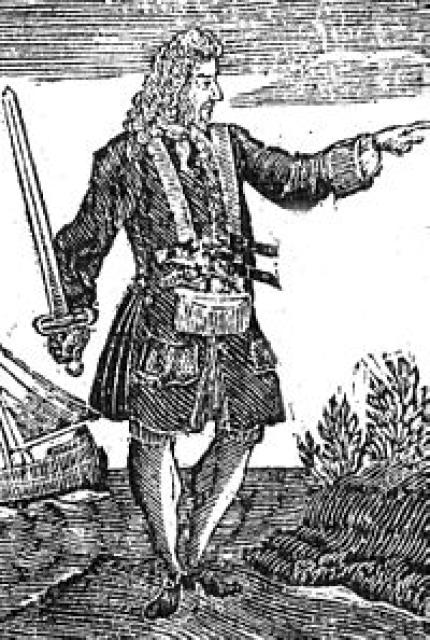
Charles Vane
 Great Britain
- Charles Vane: The Ruthless Pirate
- Encounter with Rogers
- Yeats and Blackbeard
- Vane Deposed
- A Modern-Day Robinson Crusoe
- Execution and Legacy
Charles Vane: The Ruthless Pirate
Charles Vane was an infamous English pirate known for his exceptional cruelty. He possessed exceptional navigational skills, mastery of sea charts, and vessel handling techniques, enabling him to evade pursuit multiple times.

Encounter with Rogers
Vane's early piratical exploits remain shrouded in speculation, with some researchers suggesting his involvement in the Spanish treasure salvage expedition led by Henry Jennings in 1715. Nonetheless, his first documented encounter with authorities came when Woods Rogers, appointed Governor of the Bahamas by King George I, arrived with a squadron of warships. Rogers sought to suppress piracy in the region, offering amnesty to those who surrendered. Vane defiantly rejected this offer and, upon Rogers' blockade of his haven, he daringly escaped with a small sloop after exploding a captured French prize.
Yeats and Blackbeard
Days following his escape from New Providence, Vane captured a sloop and installed Yeats as its captain. Upon seizing several English and Spanish vessels, the pirates sailed to South Carolina. Vane's disdainful treatment of Yeats prompted the latter to defect and seek amnesty. Yeats successfully surrendered and returned the sloop to its rightful owner. Vane remained vigilant for Yeats' departure but eventually withdrew northward to Ocracoke Inlet. There, he reunited with Edward "Blackbeard" Teach's crew for a grand celebration.
Vane Deposed
After their meeting, Vane continued northward. In November, his ship encountered a French vessel, which, to their dismay, hoisted the French naval ensign. Vane intended to escape, but a faction led by quartermaster John Rackham demanded boarding. Exercising his veto power, Vane prohibited the attack.
Confrontation followed, resulting in Vane's deposition due to his perceived cowardice. He was given a small sloop, weapons, and provisions and exiled along with those who had opposed boarding.
A Modern-Day Robinson Crusoe
Vane sailed his sloop to the Jamaican coast, where he captured several vessels and recruited a new crew. His reign of terror continued until a violent storm off Bonaire Island destroyed his ships and claimed the lives of most of his men. Vane miraculously survived and found refuge on a desolate island near the Gulf of Honduras. He subsisted by assisting local fishermen who frequented the island.
Years later, a ship from Jamaica commanded by former buccaneer Holford found Vane on the island. Despite Vane's pleading, Holford refused to rescue him, fearing a mutiny. Eventually, Vane managed to board another ship but was recognized by Holford upon their meeting. Holford alerted the ship's captain, who then arrested Vane.
Execution and Legacy
On March 22, 1720, Vane was found guilty of piracy and maritime robbery. He was executed on March 29, and his body, coated in tar and wrapped in chains, was displayed on tiny Gunn Cay. Charles Vane's legacy as a ruthless and skilled pirate continues to fascinate historians and adventurers to this day.