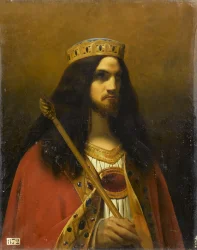
Childeric I
Childeric I ruled a Frankish power base around Tournai at a moment when Roman authority in Gaul was weakening. His life is only partly visible through later chronicles and archaeology, but the evidence portrays a leader who moved between Frankish kingship and the world of Roman military service. He was the father of Clovis I, whose reign would transform the scale and direction of Frankish rule.
A Frankish ruler in Roman Gaul
The dates and details of Childeric’s early life are uncertain. He was active in the second half of the fifth century and is generally thought to have died around 481 or 482. He ruled the Salian Franks, whose center lay near Tournai in what is now Belgium. At the time, Roman imperial power in the western provinces was fragmenting, while local rulers and military commanders competed for control.
Childeric’s position crossed those worlds. Some historians regard him as a Frankish king who served as an ally of Roman commanders; others emphasize that he may have held an administrative or military office within the late Roman system. The sources are too limited to settle the question completely. The combination of Roman and Frankish symbols in his burial suggests that both traditions mattered to his status.
The late historian Gregory of Tours says that Childeric fought at Orléans, probably alongside the Roman commander Aegidius against the Visigoths, and later campaigned near Angers. These accounts place him among the regional leaders who used military alliances to preserve and expand power as the empire’s grip on Gaul weakened.
A tomb that changed the evidence
In 1653, a mason working near the church of Saint-Brice in Tournai discovered a rich burial identified as Childeric’s. A gold signet ring bearing the Latin inscription “Childerici Regis,” meaning “of King Childeric,” linked the grave to him. It also contained weapons, gold coins, jewelry set with garnets, a gold bull’s head and horse burials. The finds offered rare material evidence of the ruler’s authority and the customs of his court.
The tomb’s objects were initially studied and later entered royal collections in France. Most of the treasure was stolen from the French Royal Library in 1831 and melted down for its gold. A small number of pieces and casts survived, leaving later historians to study both the archaeological record and early descriptions of the collection.
Father of a new Frankish dynasty
Childeric’s son Clovis succeeded him around 481 or 482. Clovis went on to unify a much larger part of Gaul under Frankish rule and embraced Christianity, giving his dynasty new political and religious alliances. Childeric’s own reign is less completely documented, but it formed an important bridge between Roman structures in Gaul and the Frankish kingdom that emerged under his son.