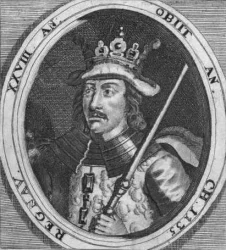
Chlodomer
- Origins and inheritance
- War with Burgundy
- Death at Vézeronce
- Sons and succession
- Place in Merovingian history
Origins and inheritance
Chlodomer was a Frankish king and one of the four sons who inherited the realm of Clovis I, the ruler whose conquests had brought much of Gaul under Frankish control. His mother was Queen Clotilde, a Burgundian princess remembered in later Christian tradition for her role in Clovis’s conversion. The sources provide little reliable detail about Chlodomer’s childhood, birth date, or education.
When Clovis died in 511, his sons divided the kingdom among themselves according to the customs of the Merovingian dynasty. Chlodomer’s share was centered on Orléans and included important territories south of the Loire, with Tours and Poitiers among its notable cities. His half-brother Theuderic ruled a separate eastern kingdom, while Childebert and Chlothar held territories centered farther north. The division did not end Frankish cooperation, but it made each king’s share a focus of dynastic competition.
War with Burgundy
In 523, Chlodomer joined his brothers in a campaign against the neighboring Burgundian kingdom. Its king, Sigismund, was captured after a military defeat and handed over to Chlodomer. The later historian Gregory of Tours says Chlodomer had Sigismund, his wife, and their sons thrown into a well near Orléans and killed. This account is the chief narrative source for the episode, written decades after the events.
Gregory presents the invasion as an act of vengeance urged by Clotilde for the death of her Burgundian relatives. Historians have treated that explanation cautiously: a land-grabbing campaign amid a Burgundian succession crisis is also a likely motive, and the family revenge story cannot be verified independently. Whatever prompted the war, Chlodomer’s execution of the captive royal family did not end the conflict. Sigismund’s brother Godomar rallied Burgundian resistance and took up the kingship.
Death at Vézeronce
Chlodomer returned to Burgundy with his brothers in 524. The Franks fought Godomar’s forces near Vézeronce, in what is now southeastern France. Chlodomer was killed in the battle, reportedly after advancing too far ahead of his own men while pursuing the enemy. The date is usually given as June 524, although accounts differ over the exact day and the outcome of the fighting. Gregory describes the Burgundians as driven back, but Godomar survived and continued to rule.
Chlodomer’s death removed the king who had led the first Frankish assault, while leaving his territory and young heirs at the center of a succession struggle. His share was ultimately absorbed by his brothers Childebert and Chlothar, who later renewed the war and conquered Burgundy.
Sons and succession
Chlodomer left three sons: Theudobald, Gunthar, and Clodoald. Gregory of Tours recounts that Childebert and Chlothar sent a messenger to their mother, Clotilde, with a sword and shears, asking whether the boys should be killed or have their hair cut and be excluded from royal rule. Gregory portrays Clotilde as declaring that she would rather see them dead than shorn. The account’s staged exchange should be understood as a later chronicler’s narrative, not a verbatim record.
In Gregory’s version, Theudobald and Gunthar were killed, while Clodoald escaped. He gave up his claim to power, entered religious life, and became known as Saint Cloud. Their father’s fate and the loss of his heirs helped clear the way for the redistribution of his kingdom among his brothers. The episode illustrates the severity of Merovingian succession politics, in which royal inheritance could bring both opportunity and lethal danger.
Place in Merovingian history
Chlodomer’s reign was brief, and his life is known mainly through military events and the succession crisis after his death. Yet his career captures a defining feature of early Frankish rule: the kingdom was repeatedly divided among royal sons, while family alliances and warfare reshaped its borders. His campaign against Burgundy began a conflict that his brothers would eventually finish, but his own branch of the family was nearly extinguished in the struggle over his inheritance.