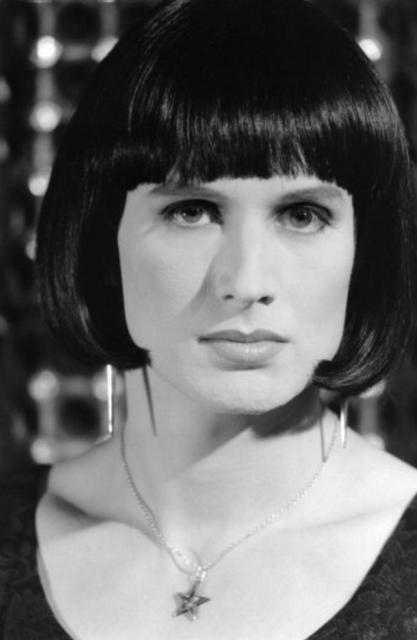
Chris Korda
 USA
- Family and Early Life
- The Church of Euthanasia
- Electronic Music and Live Performance
- Software and Later Exhibitions
- Legacy and Public Image
Chris Korda is an American artist whose work moves between electronic music, computer software, performance, and environmental activism. Korda is best known as the founder of the Church of Euthanasia, a deliberately provocative art and activism project that used the language and imagery of religion to confront population growth and ecological damage.
Family and Early Life
Born in New York City in 1962, Korda grew up in a family with strong ties to publishing and film. Her father is editor and writer Michael Korda; her grandfather was art director Vincent Korda, and filmmakers Alexander and Zoltán Korda were her great-uncles. She attended the Hammonasset School. Korda has kept much of her personal life out of the public record, while her public work has consistently focused on art, technology, and environmental questions.
The Church of Euthanasia
In 1992, Korda founded the Church of Euthanasia, a satirical organization designed to provoke debate about overpopulation and the environmental crisis. Its slogan, “Save the Planet, Kill Yourself,” and its deliberately shocking positions drew immediate attention. Korda framed the project as performance and political communication: it borrowed the form of a religious institution to make audiences confront ideas they might otherwise avoid. The church’s campaigns and public actions also attracted strong criticism for their extreme rhetoric.
In 1995, Korda and Lydia Eccles created “Unabomber for President,” a political action campaign supporting arguments about industrial society found in Ted Kaczynski’s manifesto, while explicitly distinguishing their campaign from support for Kaczynski himself. The project extended Korda’s interest in using satire and political spectacle to unsettle conventional debate.
The Church’s multimedia work became especially controversial after the September 11, 2001 attacks. A video titled “I Like to Watch,” posted on the organization’s website, mixed television footage of the attacks with pornographic and sports imagery. The video was widely criticized as offensive. It remains one of the clearest examples of how Korda’s confrontational methods could command attention while alienating viewers.
Electronic Music and Live Performance
Alongside activism, Korda developed a career in electronic music. Experimenting with synthesizers and computer software from the late 1980s, Korda released albums including Six Billion Humans Can’t Be Wrong (1999), The Man of the Future (2003), and Akoko Ajeji (2019). The 2003 album came out on the German label International Deejay Gigolo Records, and Korda toured in Europe in support of it.
Korda has performed at events around the world, including Barcelona’s Sónar festival in 2001. Live sets often incorporate software Korda created, making the computer both an instrument and part of the performance. This fusion of music and programming became a defining feature of the work.
Software and Later Exhibitions
Korda’s software projects include Fractice, a fractal renderer released in 2008; WaveShop, a lossless audio editor introduced in 2013; and ChordEase, a tool designed to make it easier to play notes on MIDI instruments, released in 2014. ChordEase was presented at the 2015 International Conference on New Interfaces for Musical Expression. These projects reflect a recurring theme in Korda’s practice: building tools that expand the ways people can create with computers.
The visual-art side of Korda’s work received renewed attention in the 2020s. Le Confort Moderne presented a retrospective in 2022, and Korda’s work appeared in the 2024 exhibition Artist’s Con(tra)ception at Kölnischer Kunstverein. Critics have described the work as an examination of how political and religious language operates in mass culture, while other responses have objected to its provocative imagery and messages.
Legacy and Public Image
Korda’s career resists a single label. The same artist who makes club-oriented electronic music also builds creative software and stages confrontational performances about environmental collapse. Supporters see an inventive critique of consumer society and media; detractors have found the tactics needlessly offensive. That tension is central to Korda’s public image: the work is meant to provoke a response, even when the response is rejection.


