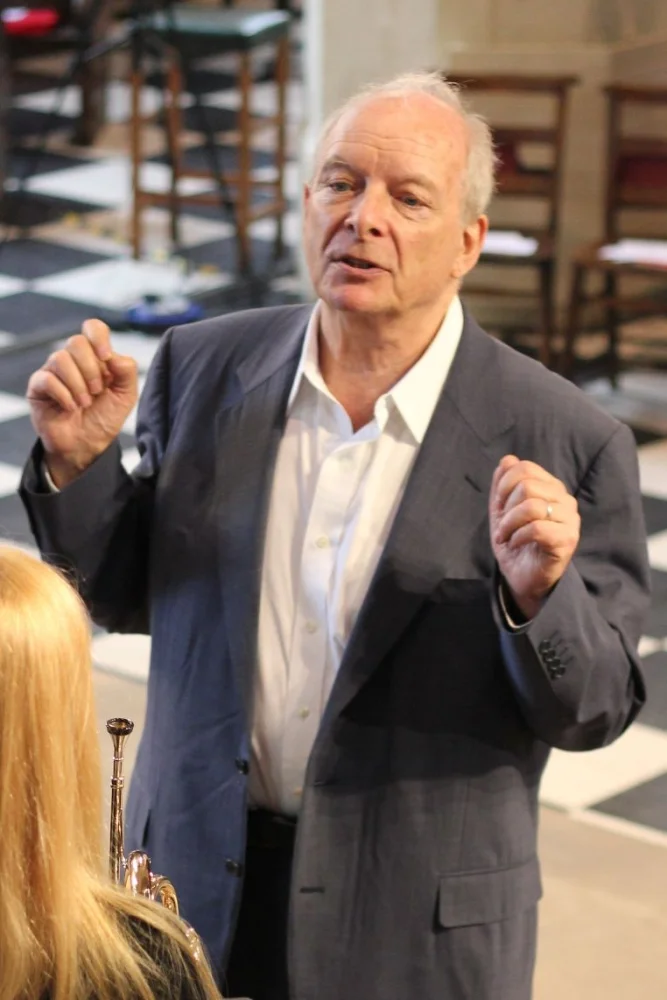
Christopher Hogwood
- Education and Early Music
- Founding the Academy of Ancient Music
- Conductor and Scholar
- Later Years and Legacy
Christopher Hogwood helped change how audiences heard Baroque and Classical music. A harpsichordist, scholar, and conductor, he combined close study of historical sources with performances on period instruments. The ensemble he founded, the Academy of Ancient Music, became one of the most influential forces in the late twentieth-century early music revival.
Education and Early Music
Hogwood was born in Nottingham on 10 September 1941. He entered Pembroke College, Cambridge, in 1960, initially intending to study Classics and pursue archaeology. Music soon became the center of his work. After graduating, he spent a year in Prague on a British Council scholarship, continuing his harpsichord studies with Zuzana Růžičková. He later studied with Gustav Leonhardt in Amsterdam.
Hogwood returned to Cambridge and became involved with a generation of musicians who were rediscovering early music. In the 1960s he worked with conductor Neville Marriner’s Academy of St Martin in the Fields and became a founding member of the Early Music Consort of London, which he established with David Munrow. As a keyboard player, Hogwood was especially drawn to the instruments and performance practices for which older music had originally been written.
Founding the Academy of Ancient Music
In 1973 Hogwood founded the Academy of Ancient Music, an ensemble devoted to Baroque and early Classical repertoire played on period instruments. At a time when this approach was still regarded as specialized, the orchestra made historically informed performance accessible to a wide audience through concerts and recordings.
Under Hogwood’s direction, the Academy recorded more than two hundred works, including complete cycles of the Mozart and Beethoven symphonies. Its performances of Handel, Bach, Haydn, and Purcell brought a distinctive transparency and rhythmic energy to familiar works, while also introducing audiences to repertoire less often heard in concert halls. Hogwood remained music director until 2006, when he became director emeritus.
His recording of Handel’s Messiah with the Academy, released in 1980, became a landmark for its historically informed approach. The ensemble’s growing international profile helped make period instruments a familiar part of musical life rather than an archival curiosity.
Conductor and Scholar
Hogwood’s work extended well beyond the Academy. He served as artistic director of Boston’s Handel and Haydn Society from 1986 to 2001 and later became its conductor laureate. He held teaching and visiting posts at Harvard, Cornell, Cambridge, the Royal Academy of Music, and Gresham College, where he was Professor of Music from 2010 to 2014.
Scholarship was central to his conducting. He prepared editions for performance, wrote extensively about music history, and produced a widely respected biography of George Frideric Handel, first published in 1984 and revised in 2007. His books and research helped connect the work of the musicologist with the practical decisions made in rehearsal: which instrument to use, how to shape a phrase, and what historical evidence could tell performers about a composer’s intentions.
Awards included the CBE, honorary doctorates, and the Halle Handel Prize in 2008. He was also a collector of historical keyboard instruments and an advocate for the clavichord, a delicate domestic instrument that rarely receives the spotlight in large concert venues.
Later Years and Legacy
Hogwood continued teaching and performing into his final years. He died at his home in Cambridge on 24 September 2014, aged 73, after a brain tumour.
His influence is heard in the way period instruments and historically informed performance have become part of mainstream classical music. Through the Academy of Ancient Music, his recordings, and his writing on Handel and other composers, Hogwood brought scholarship into the concert hall and showed how historical research could reshape a listener’s experience of familiar music.


