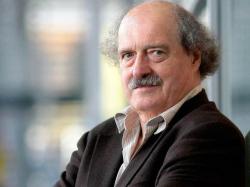
Claude Simon
 France
Biography of Claude Simon
Claude Eugène Henri Simon was a French novelist and was awarded the Nobel Prize in Literature in 1985. Born in Tananarive, Madagascar, Simon's early novels showcased distinctive stylistic features, composition techniques, and themes. These included a rejection of traditional chronological narrative, the use of multiple perspectives, digressions from the main narrative line, the dominant role of memory, and the disarming role of chance.
Simon's father, Louis Antoine Simon, was an army officer who served in the French colonial forces and was killed in 1914, at the beginning of World War I. Louis Antoine came from a peasant family in eastern France, while the writer's mother, Suzanna (Denamur) Simon, came from a poor noble family from Rossillon in southeastern France. Claude spent his childhood in Perpignan, a town on the Spanish border, where he was raised by relatives on his mother's side, primarily his uncle, her brother.
From the ages of 7 to 16, Claude studied at Collège Stanislas in Paris, where he played rugby and painted. Before the war, Simon studied painting with André Lhote in Paris and traveled through Europe and the Soviet Union. From 1934 to 1935, he served in the 31st Dragoon Regiment of the French Army. During the Spanish Civil War, Simon volunteered and went there, but eventually became disillusioned with the Republican movement. In 1939, when World War II broke out, Simon returned to the Dragoon Regiment and following in his father's footsteps, became a cavalry officer and later a brigadier general. He participated in the Battle of Maas in May 1940, miraculously surviving, and was taken prisoner first in a camp near Mühlberg, Saxony, and then in a prisoner-of-war camp in France. He escaped, and participated in the Resistance movement in Perpignan.
After the war, Simon returned to Paris and married Yvonne Dusing in 1951. From the early 1950s, the writer lived either in his Parisian apartment in the Latin Quarter or in a property near the village of Sals, north of Perpignan, in the eastern Pyrenees. In 1978, Simon married Rhea Caravay, a Greek woman.
Simon started his literary career before the war and completed his first novel, "Le Tricheur" ("The Trickster"), while participating in the Resistance in Perpignan. "Le Tricheur" was published in 1945, at the end of the war, and received mixed reviews. His early works, including the autobiographical novel "La Corde raide" (The Tightrope, 1947), "Gulliver" (1952), "Le Sacre du printemps" (The Rite of Spring, 1954), and "Le Vent" (The Wind, 1957), showed the influence of writers such as Faulkner, Proust, Conrad, and Dostoevsky. These early literary experiences also revealed Simon's interest in time, memory, order, chaos, and associative and fragmented composition, which became characteristic of his later books.
In his novels, Simon builds his works according to the laws of "collage," where all events and experiences, like on a canvas, are placed on the same level. He is also interested in questions related to the philosophy of perception. In 1960, Simon signed "Declaration 121," a manifesto by French intellectuals in support of the Algerian independence movement. His novel "La Route des Flandres" (The Flanders Road), published the same year, won the Prix Express for 1961. The novel conveys the memories and impressions of wartime, particularly the Battle of Maas, in which the main character, George, like the author, participated. American researcher Karen Gould focused on the "microcosm" of George's life experience, noting its archetypal nature.
Simon's works after "La Route des Flandres" are known for their experimental composition and wordplay. Critics have emphasized the importance of language and semiotic analysis in his texts. In 1985, Simon was awarded the Nobel Prize in Literature for his poetic and pictorial elements in his writing, as well as his deep understanding of the role of time in portraying humanity. The Swedish Academy recognized his pessimism, tragic view of history, and his attachment to duty and traditions.
In his Nobel Lecture, Simon highlighted the importance of showing rather than proving, creating rather than recreating, and opening rather than expressing. He believed that novels, like music, are not simply reproductions of themes but expressions of harmony. Jean Duffi, a researcher, considered Simon's art revolutionary, transforming traditional techniques and conveying the meaning of life in a renewed narrative form.