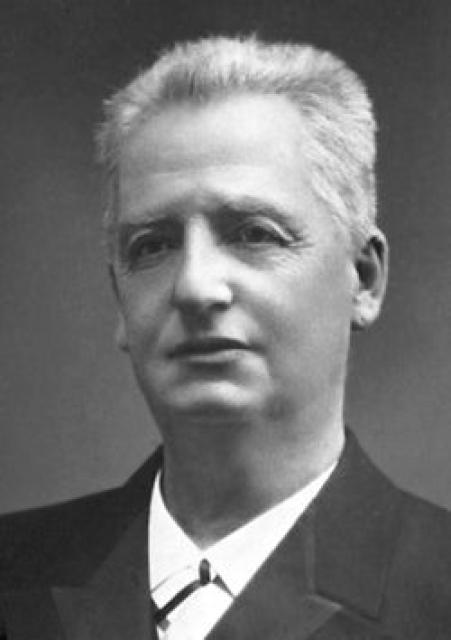
Claus Pontus Arnoldson
 Sweden
- Knut Hjalmar Leonard Hammarskjöld: Early Life and Education
- Philosophical Beliefs and Activism
- Political Career and Swedish Neutrality
- The Norwegian Crisis and the Nobel Peace Prize
- The Universal Referendum and Post-War Advocacy
Knut Hjalmar Leonard Hammarskjöld: Early Life and Education
Born in the port city of Gothenburg, Sweden, on July 31, 1862, Klas Pontus Arnoldson was the son of musician Olof Arnoldson and Inga Hagbom von Seth. His father's passing at the age of 16 forced him to abandon his formal education. Consequently, Arnoldson joined the railway service, where he spent 21 years working his way up to the position of station master. During this time, he dedicated himself to self-education, immersing himself in philosophy, history, and religion.
Philosophical Beliefs and Activism
Inspired by the liberal theology of the 19th century, particularly the humanitarian principles of Unitarianism, Arnoldson rebelled against religious dogmatism. Convinced that the advancement of human reason and freedom of thought could ameliorate human suffering, he began advocating for these ideals in newspaper articles during the 1870s.
Arnoldson's belief in the power of human intellect extended to his approach to international politics. Appalled by the bloodshed of the 1864 war, in which Prussia and Austria wrested control of the Danish duchies of Schleswig and Holstein, as well as the Franco-Prussian War of 1870-1871, he concluded that Otto von Bismarck's efforts to unify Germany under Prussia's leadership were not worth the devastation it brought.
Arnoldson's growing concern over the rising militarism among major European powers prompted him to resign from his railway job in 1881 and dedicate himself to journalism and the cause of peace. Despite the lack of a formal degree, he quickly gained prominence as a writer. His articles in Swedish newspapers and magazines commanded widespread attention.
By 1882, Arnoldson's reputation as a publicist and orator had reached such a level that he was elected to the lower house of the Swedish parliament. He channeled all his energies into championing individual rights and democratic principles, advocating for religious tolerance and the mitigation of militarism.
Political Career and Swedish Neutrality
As a member of parliament, Arnoldson pushed for a resolution that would establish Sweden's neutrality (eventually achieved in 1914). He recognized that small nations like Sweden could not compete militarily with powers like Germany and Great Britain. Arnoldson also urged the Scandinavian countries to unite on the basis of neutrality, but this effort proved unsuccessful.
Arnoldson was among the founders of the Swedish Peace and Arbitration Society, established in 1883. He continued his journalistic endeavors alongside his parliamentary duties, editing the peace-oriented periodical "Tiden" (1883-1885), "Fredsvannen" (1885-1888), and "Nordsvenska Dagbiadet" (1892-1894). He also authored several books on peace and religion.
Convinced that he could be more effective as a publicist, Arnoldson declined to run for reelection to parliament in 1887. His ability to articulate abstract concepts in clear and accessible language made him one of the most popular speakers in the early European peace movement.
In 1889-1890, Arnoldson embarked on a lecture tour throughout Sweden and Norway, advocating for international arbitration as a means of preventing armed conflict. His speeches resonated with the Norwegian parliament, which in 1890 became the first national assembly to declare its support for arbitration.
The Norwegian Crisis and the Nobel Peace Prize
From 1815 onward, Norway had been united with Sweden in a personal union, but in 1895, Norway's growing desire for autonomy threatened the union. Sweden initially rejected Norway's demands, but Arnoldson, who had studied the issue during his visit, saw it as an opportunity to test the efficacy of arbitration.
Although arbitration ultimately did not take place, Arnoldson's efforts were instrumental in persuading Swedish politicians to accept Norway's separation. In 1905, the Norwegian parliament voted for independence.
For his role in resolving the Norwegian conflict, Arnoldson and Danish pacifist Fredrik Bajer were awarded the Nobel Peace Prize in 1908. The award was met with outrage by some in Sweden, who viewed Arnoldson as a traitor. However, his nomination was unanimously supported by the Swedish group of the Inter-Parliamentary Union and 34 members of the Swedish parliament.
The Universal Referendum and Post-War Advocacy
In his Nobel lecture, "The World Referendum," Arnoldson maintained, "There is nowadays a possibility that no contested international question shall lead to war if it is submitted to the judgment of an expert court." He referred to the resolution passed by the 1907 Hague Peace Conference, which once again urged governments to "examine" the feasibility of reducing military expenditures (a plea initially raised at the 1899 Hague Conference).
"Since mankind now understands the burdens of war," Arnoldson declared, "more than a 'consideration' will be required to cast them off — perhaps to repeal them forever. If this is held to be impossible, it is not because of any technical difficulty, but because of lack of determination."
Arnoldson proposed a global referendum, in which adult citizens of all nations would be asked to sign the following declaration: "Provided that all nations abolish their military forces and confine themselves to an international police, I, the undersigned, wish to see my nation do the same." In his view, such a referendum would galvanize governments into achieving universal disarmament and resolving disputes peacefully. Pacifism, Arnoldson argued, was an imperative step in human civilization's evolution away from barbarism.
Despite financial hardship, Arnoldson donated the prize money to various pacifist organizations with which he was affiliated. Even as World War I erupted, he continued to promote his referendum plan and champion the cause of peace.
Klas Pontus Arnoldson married twice, first to Awa Berhardina Wahlgren in 1869, from whom he divorced in 1903. He married Edith-Victoria Blomsköld in 1903. He died in Stockholm on December 20, 1933, at the age of 71.