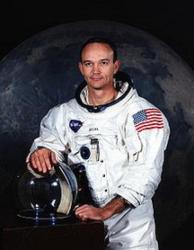
Clayton Anderson
 USA
USA- Clayton C. Anderson: American Aerospace Engineer and NASA Astronaut
- Professional Trajectory
- NASA Astronaut Career
- Spaceflight Experience
- STS-131 (2010)
- Accolades and Recognition
- - Medal "For Merit in Space Exploration" (2011)
Clayton C. Anderson: American Aerospace Engineer and NASA Astronaut
Early Life and EducationClayton C. Anderson was born in Omaha, Nebraska, but identifies Ashland, Nebraska, as his hometown. He completed his schooling at Ashland-Greenwood High School in 1977. Anderson went on to pursue higher education, earning a Bachelor of Science in Physics from Hastings College in 1981 and a Master of Science in Aerospace Engineering from Iowa State University in 1983.
Professional Trajectory
In 1983, Anderson joined the Mission Planning and Analysis Division at the Johnson Space Center, where his work focused on calculating trajectories for shuttle missions. He rose through the ranks at the Flight Operations Directorate, becoming the trajectory lead for the Atlantis STS-34 mission (Galileo probe launch) in 1988. Anderson also played a role in supporting the Discovery STS-31 (Magellan probe launch), Atlantis STS-37 (gamma ray observatory launch), and Atlantis STS-46 (tethered satellite launch) missions.
Throughout his career, Anderson held various leadership positions, including head of the Flight Planning and Trajectory Operations Division, Chief of Flight Trajectory Branch, and Head of the Planning and Computational Dynamics Operations Division. In 1993, he was appointed Chief of the Flight Design Division. Anderson also served as the Mission Control Center Houston Emergency Officer from 1996 to 1998.
NASA Astronaut Career
In June 1998, Anderson was selected as a NASA astronaut candidate. He underwent comprehensive space preparation and was qualified as a flight specialist in August 1999. After completing extravehicular activity training in November 2002, Anderson served as a spacecraft communicator during shuttle missions and provided technical support to the crew during the fourth International Space Station (ISS) expedition.
Anderson's schedule included work on the shuttle's cockpit avionics upgrade project. In December 2003, he was assigned as a backup flight engineer for the 12th ISS expedition and a primary flight engineer for the 14th ISS expedition. However, he was later removed from the latter crew due to schedule delays. Anderson joined the backup crew for the 14th ISS expedition in May 2006 and was promoted to the 15th ISS expedition primary crew in June 2006.
Spaceflight Experience
STS-117 (2007)On June 8, 2007, Anderson embarked on his first spaceflight as a mission specialist for STS-117 and a flight engineer on the 15th ISS expedition. He became the 460th person and 292nd American to travel to space. During his six-month stay on the ISS, Anderson completed three spacewalks, totaling 18 hours and 10 minutes of extravehicular activity.
STS-131 (2010)
From April 8 to 20, 2010, Anderson participated in his second spaceflight on STS-131, a mission to the ISS.
Accolades and Recognition
Anderson has received numerous accolades for his contributions to space science, including: