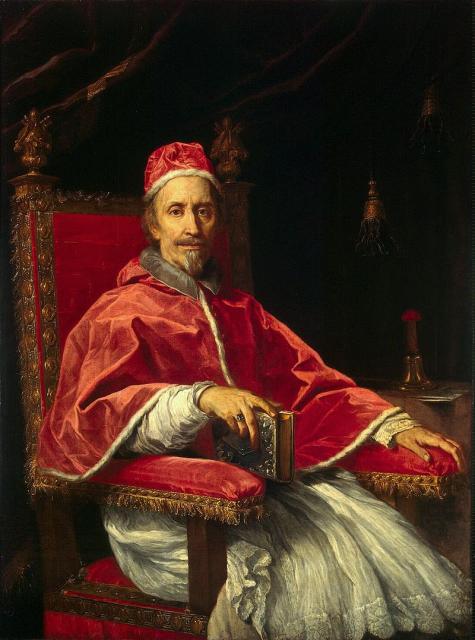
Clemens IX
 Italy
Italy- Pope Clement IX
- Diplomatic Career and Rise to the Papacy
- Papacy
- Popularity and Charity
- Patron of Arts
- Struggle Against the Turks
- Death and Burial
Pope Clement IX
Birth and Early LifeOn January 28, 1600, Giulio Rospigliosi was born into a noble family in Pistoia, Italy. As a youth, he studied under the Jesuits before pursuing philosophy and theology at the University of Pisa, where he later became a professor.
Diplomatic Career and Rise to the Papacy
In 1644, Rospigliosi served as papal nuncio to Spain. During the pontificate of Pope Innocent X (1644-1655), he lived in exile due to the pope's disdain for the Barberini family and their supporters, which included Rospigliosi. However, under Pope Alexander VII, he was made a cardinal in 1657 and became prefect of the Congregation for the Affairs of the State, a position equivalent to today's Secretary of State. Upon the death of Alexander VII in 1667, under pressure from France, the conclave elected Rospigliosi, who took the name Clement IX.
Papacy
Clement IX's nepotism was moderate, with his relatives abstaining from affairs of the Church and Papal States. However, the Roman Curia, rather than the pope himself, largely governed the Church and its policies. The Italian aristocratic families, who owed their careers to the nepotism of previous popes, played a significant role in shaping these policies.
Little of note transpired during Clement IX's brief reign, aside from his brokering the Peace of Aachen in 1668, which ended the War of Devolution.
Popularity and Charity
Clement IX enjoyed popularity among the people not for his piety or administrative competence, but for his charitable nature and affable demeanor. Twice a week, he served as confessor at St. Peter's Basilica, hearing all who wished to confess. He frequently visited hospitals and gave alms generously to the poor. In an era of nepotism, he did little to enrich his family. In his humility, he even forbade his name to be displayed on buildings constructed during his pontificate.
Patron of Arts
Clement IX was a patron of painter Nicolas Poussin. He was an avid enthusiast of opera, writing librettos (including one for Stefano Landi's 1634 opera "Sant'Alessio") and funding the construction of a theater on the site of an old city prison. He adorned the city with sculptures by Gianlorenzo Bernini. He also opened the first public opera house in Rome, and during the Carnival of 1668, the spiritual opera "La Baltasara" premiered at Palazzo Rospigliosi, with a libretto by the pope and music by Antonio Maria Abbatini. Bernini designed the sets for this "opera scenica sacra."
Struggle Against the Turks
Just before his death, Clement IX received news of the loss of Candia (present-day Heraklion), the last Christian stronghold on Turkish-occupied Crete. A papal fleet sent to aid under the command of his nephew, Vincenzo Rospigliosi, had been defeated on September 6, 1669. The news brought great distress to the pope.
Death and Burial
Clement IX died in Rome in December of the same year, likely from a stroke. His successor, Pope Clement X (1670-1676), commissioned an elaborate tomb for him in the Basilica of Santa Maria Maggiore.


