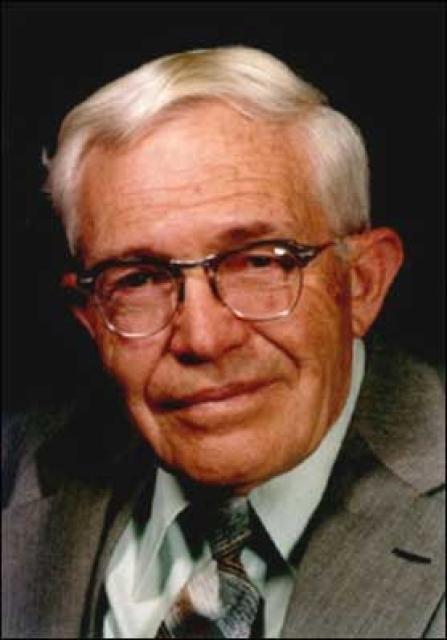
Clyd Tombaugh
 USA
USA- Clyde Tombaugh: Discoverer of Pluto
- Crafting His Own Telescope
- Joining Lowell Observatory
- The Search for Planet X
- The Discovery of Pluto
- Recognition and Legacy
- Continued Astronomical Endeavors
- Later Career and Retirement
Clyde Tombaugh: Discoverer of Pluto
Early Life and Interest in AstronomyClyde Tombaugh was born in Streator, Illinois, on February 4, 1906. Influenced by his father's passion for astronomy, Tombaugh began making independent observations of the sky while still in high school.
Crafting His Own Telescope
When a factory-made 2.25-inch refractor proved insufficient, Tombaugh constructed a 9-inch telescope using old parts from farm machinery and his father's 1910 Buick. With this telescope, he produced detailed sketches of Jupiter and Mars.
Joining Lowell Observatory
Some of Tombaugh's sketches were sent to Lowell Observatory in Flagstaff, Arizona, for evaluation. Impressed by his work, the observatory offered him a position in 1929. He was tasked with observing with the new 13-inch photographic refractor.
The Search for Planet X
In 1905, Lowell had proposed the existence of a planet beyond Neptune, dubbed Planet X. Tombaugh joined a years-long program to locate it. Using a special blink comparator, he meticulously compared images of the night sky taken on different nights, looking for any slight shifts in position that might indicate a moving celestial body.
The Discovery of Pluto
On February 18, 1930, Tombaugh identified a faint star-like object that appeared to have moved in two photographic plates taken over several days. Subsequent observations confirmed it as a new planet, which was named Pluto. The discovery was announced on March 13, 1930, the 75th anniversary of Lowell's birth.
Recognition and Legacy
Tombaugh's discovery of Pluto earned him the Jackson-Gwilt Medal of the Royal Astronomical Society in 1931. He went on to study at the University of Kansas, graduating in 1936.
Continued Astronomical Endeavors
Beyond Pluto, Tombaugh investigated approximately 90 million star images, discovering six star clusters, two comets, 775 asteroids, and numerous variable stars. He also studied the distribution of galaxies, identifying several galaxy clusters and one supercluster.
Later Career and Retirement
After World War II, Tombaugh held positions at the Aberdeen Proving Ground in New Mexico and the University of New Mexico, where he led the Planetary Studies Group. He retired in 1973 but remained an active lecturer and observer, using his beloved 9-inch telescope until the end of his life. Tombaugh passed away in 1997 at the age of 90.