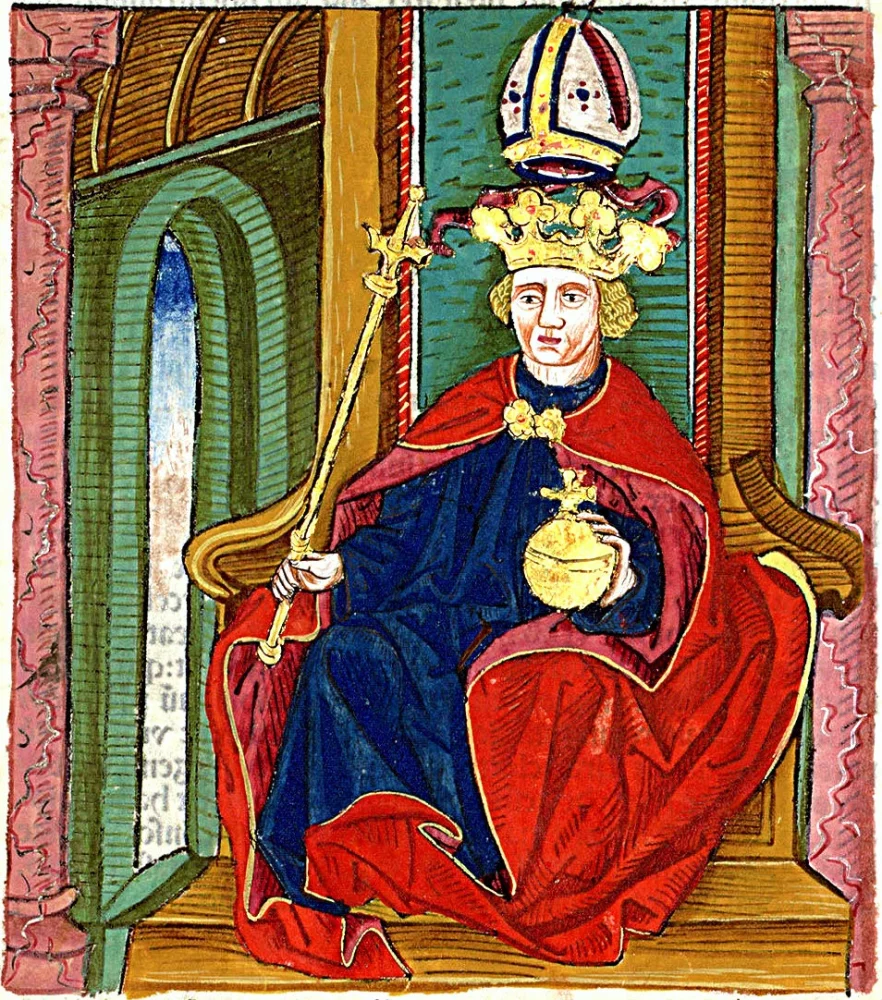
Coloman
Coloman, often called “the Learned” or “the Book-Lover,” was king of Hungary from 1095 to 1116 and expanded his rule into Croatia. He was known for his education, legal reforms, and careful diplomacy at a time when the First Crusade brought armed groups across his kingdom. His reign strengthened Hungary’s position in central Europe, but it was also marked by a bitter struggle with his younger brother Álmos.
A learned king takes the throne
Coloman was born around 1070, the son of King Géza I of Hungary. He and his brother Álmos were raised at the court of their uncle, King Ladislaus I. When Ladislaus died in 1095, Coloman succeeded him, despite the king’s earlier preference for Álmos. Coloman’s learning earned him a reputation unusual among medieval rulers, though he was also a determined political leader.
The First Crusade began during Coloman’s reign. As crusading armies moved toward the Byzantine Empire, some groups entering Hungary engaged in violence and looting. Coloman allowed the more disciplined forces to cross but used military action to control those who threatened the kingdom. His handling of the passage helped protect Hungary from further disorder while keeping open the route east.
Croatia, law, and political rivalry
Coloman extended Hungarian authority into Croatia and Dalmatia. After a campaign in 1097 and subsequent political negotiations, he was crowned king of Croatia in 1102. The arrangement brought the two kingdoms under a shared monarch, though local elites retained important roles. The precise terms of the union are debated by historians, but the connection between the Hungarian crown and Croatia became a defining feature of regional politics for centuries.
Coloman’s laws addressed a wide range of issues, from church affairs to public order. One famous provision stated that cases involving strigae, a term often translated as witches, should not be pursued because such beings did not exist. The wording reflected a specific legal category and should not be taken to mean that medieval people rejected all beliefs in magic or sorcery.
Relations with Álmos remained unstable. Coloman granted his brother a duchy, but Álmos repeatedly challenged the king’s authority. In the later years of the reign, Coloman ordered Álmos and his young son Béla blinded, a harsh act intended to prevent further claims to the throne. Béla nevertheless survived and later became king.
Legacy
Coloman died in 1116 and was succeeded by his son Stephen II. His reputation as an educated ruler was joined to practical achievements: he managed the pressures of the crusading movement, extended Hungarian influence into Croatia, and issued laws that shaped the kingdom’s administration.
His reign left a complex legacy of state-building and dynastic violence. The union with Croatia broadened the reach of the Hungarian monarchy, while the conflict with Álmos revealed the dangers of succession disputes within the Árpád dynasty. Later generations remembered Coloman as both a scholar-king and a forceful defender of royal authority.