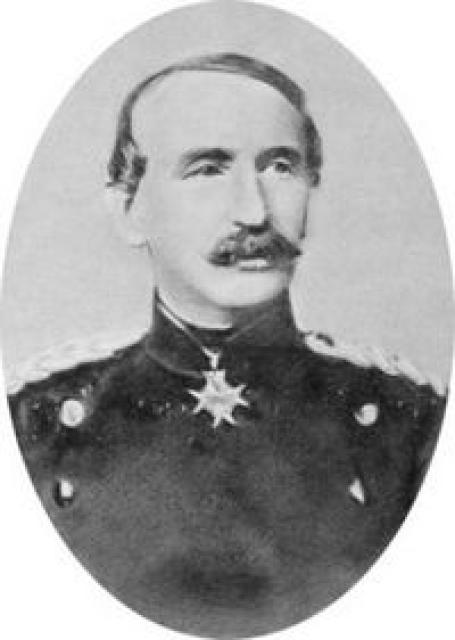
Constantin Alvensleben
 Germany
- Early Life and Military Education
- Military Career
- Danish-Prussian War
- Austro-Prussian War
- Franco-Prussian War
- Legacy
Early Life and Military Education
Gustav August Karl von Alvensleben was born on August 26, 1809, in Eichenbarleben, Prussia. He received his education at the Berlin Cadet Corps and was commissioned as a second lieutenant in 1827.
Military Career
Over the next three decades, Alvensleben rose through the ranks of the Prussian army. He became a major in 1858, lieutenant colonel in 1859, and colonel in 1860. In the same year, he took command of the 1st Guards Grenadier Regiment.
Danish-Prussian War
During the Danish-Prussian War of 1864, Alvensleben led his regiment to victory at the Battle of Dybbøl. For his actions, he was promoted to major general.
Austro-Prussian War
In the Austro-Prussian War of 1866, Alvensleben commanded the 2nd Guards Brigade. At the Battle of Königgrätz, he launched a bold attack on the Austrian positions at Horenoves and Chlum, contributing to the Prussian victory. He was subsequently awarded the Pour le Mérite order.
Franco-Prussian War
At the outbreak of the Franco-Prussian War in 1870, Alvensleben was appointed commander of the 3rd Army Corps. He played a crucial role in the Battle of Spicheren and the Battle of Rezonville, where his corps held off the entire French army until reinforcements arrived.
During the Siege of Metz, Alvensleben's corps participated in the Battle of Gravelotte. He later took part in the advance on Orléans and the pursuit of the enemy up the Loire Valley.
Legacy
Alvensleben's distinguished military service earned him widespread recognition. He was awarded the Order of St. George by Emperor Alexander II of Russia and the Order of the Black Eagle by Emperor William I of Germany.
After the war, Alvensleben served briefly before retiring in 1873. He died in Berlin on March 28, 1892. His name remains revered in German military history, with several fortifications and regiments named after him. His brother, Gustav, was also a Prussian general and commanded the 4th Army Corps during the Franco-Prussian War.