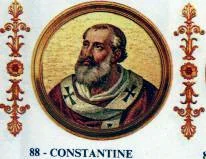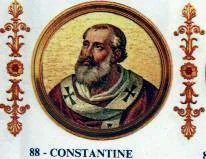
Constantine
Constantine was bishop of Rome from 708 to 715, during a period when the papacy remained closely entangled with the politics of the Byzantine Empire. Born in Syria, he was one of several eastern-born popes of the era. His pontificate is especially remembered for a rare journey to Constantinople, where he met Emperor Justinian II and negotiated amid disputes over church authority and imperial policy.
Election and Early Pontificate
Constantine became pope on 25 March 708, succeeding Sisinnius, whose pontificate had lasted only a few weeks. He led the Roman church at a time when the emperor in Constantinople claimed authority over much of Italy, while local rulers and the Lombards contested control of the peninsula. The bishop of Rome thus had to navigate both spiritual concerns and the practical politics of an eastern empire whose influence in Italy was under pressure.
Little is known about Constantine’s earlier life beyond his Syrian origin. His election followed a period in which several popes came from the eastern Mediterranean, reflecting the diverse communities and connections of the early medieval church. His role demanded diplomacy with imperial officials and with the clergy and population of Rome.
Journey to Constantinople
In 710, Constantine traveled to Constantinople at the invitation of Justinian II. A papal visit to the imperial capital was exceptionally rare, and the journey gave the emperor and pope an opportunity to address tensions that had built up over church governance and the decisions of the Quinisext Council. The council’s canons, issued in 692, had not been fully accepted in Rome. The precise outcomes of the meetings remain debated, but Constantine’s visit helped restore a measure of dialogue between the two centers of Christian authority.
The pope’s travels also included meetings with communities and officials along the route, and chronicles record his consecration of bishops during the journey. His reception at Constantinople was described as respectful, reflecting the importance Justinian attached to securing cooperation with Rome. Constantine returned to Italy in 711, shortly before Justinian was overthrown and killed later that year.
Legacy
Constantine continued to lead the church through the end of his life, dying in Rome on 9 April 715. He was succeeded by Gregory II. His pontificate did not resolve the larger conflicts between Rome and Constantinople, but his willingness to meet the emperor in person marked a notable diplomatic effort.
Remembered chiefly for this journey, Constantine’s career illustrates the papacy’s position in an age when religious authority and imperial power were closely linked. His background and diplomacy connected Rome to the eastern Mediterranean even as political control in Italy grew increasingly uncertain.