Constantius III
Constantius III rose from the ranks of the Western Roman army to become the most powerful official in Emperor Honorius’s court. An effective general during a period of invasion and civil war, he helped restore imperial control in parts of Gaul and Spain. His elevation as co-emperor in 421 came late in a career that had already shaped the empire’s survival.
A general in a divided empire
Flavius Constantius was born around 370, probably at Naissus in the Balkans. He became the leading military figure in the Western Roman Empire during Honorius’s reign. In 411 he defeated the usurper Constantine III in Gaul and suppressed other challenges to the emperor’s authority.
Constantius later campaigned against the Visigoths, who had entered Gaul and Italy. Negotiations produced a settlement in 418 that allowed the Visigoths to establish themselves in Aquitaine as federated allies of Rome. The arrangement did not restore Roman control over every lost territory, but it helped stabilize a dangerous frontier.
Marriage and imperial elevation
In 417 Constantius married Galla Placidia, Honorius’s half-sister, after her return from captivity among the Visigoths. Their children included Valentinian, the future emperor Valentinian III, and Honoria. The marriage made Constantius part of the imperial family and strengthened his political position.
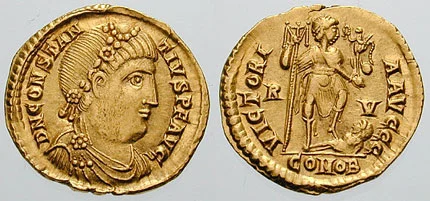
On 8 February 421, Honorius elevated Constantius to the rank of Augustus, or co-emperor, under the name Constantius III. The eastern court did not recognize the elevation, and the arrangement lasted only a few months.
A short reign and lasting influence
Constantius died at Ravenna on 2 September 421, before he could consolidate his imperial position. His son Valentinian III later became emperor, with Galla Placidia serving as regent during his youth.
Although his reign was brief, Constantius’s military leadership helped preserve Honorius’s government during a period of repeated usurpations and territorial crises. His career also shows how military authority and dynastic marriage could lift a general to the highest rank in the late Roman state.