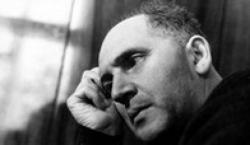
Cristopher Merlou
 Great Britain
- Christopher Marlowe - The Enigmatic Playwright
- Early Life and Education
- Writing Career and Controversy
- Legacy and Influence
Christopher Marlowe - The Enigmatic Playwright
Christopher Marlowe, an English playwright, was praised by his contemporary Michael Drayton for his soul-stirring and heart-touching lines. Marlowe's concise verses were bathed in the bubbling springs of his dramas, preserving the wild madness of the early poets. His poems were made transparent by the air and fire that fueled his enthusiasm. Only the poet's mind could possess such passion.
Early Life and Education
Born on February 26, 1564, Christopher Marlowe was the son of a shoemaker from Canterbury. In 1579, he enrolled in the King's School in Canterbury, and later, in 1581, he continued his studies at Corpus Christi College in Cambridge, where he earned a bachelor's degree three years later. He furthered his education at Cambridge, obtaining a master's degree. Rumors circulated about his periodic mysterious disappearances from college, and in 1587, the Secret Council sent a special explanatory letter to Cambridge, stating that Christopher Marlowe was in the service of the British government and was required to travel from time to time, sometimes abroad. The letter indicated that Marlowe should not be criticized "by those ignorant of state affairs" for his absences.
Writing Career and Controversy
After Cambridge, Marlowe moved to London, where he began writing plays for the theater. He was arrested by constables in Shoreditch for inciting riots. The following year, playwright Thomas Kyd was arrested for defamation against Protestant refugees in London. During the search, several documents were found, the contents of which were considered heretical. Under torture, Kyd revealed that Marlowe was the author of these papers, who by then had already gained a reputation as an "atheist" in the district, which in the Elizabethan era could imply various deviations from orthodoxy. Kyd claimed that Marlowe was the author of "vile and heretical jests denying the divinity of Jesus Christ." Secret informant Richard Baines confirmed part of Kyd's testimony against Marlowe in a "report detailing Christopher Marlowe's perverted judgments on religion and the word of God." According to Baines' report, Marlowe believed that "the Apostle John was the lover of Christ and therefore enjoyed his special attention; he used John like the sinners of Sodom." Perhaps even more shocking is the accusation that Marlowe was convinced that "anyone who does not love boys and does not smoke tobacco is a complete fool."
On May 18, 1593, the Privy Council sanctioned Marlowe's arrest, but he was released two days later under a non-departure bond. On May 30, while spending time at a tavern in Deptford with Nicholas Skeres, Robert Poley, and Ingram Frizer, Marlowe was killed by Frizer. According to Frizer's later statement, an argument arose over the payment of the bill. Allegedly, Marlowe pulled a knife from Frizer's belt and tried to strike him with it, but in self-defense, Frizer took the knife from Marlowe and plunged it into his right eye. The knife deeply penetrated his head, and Christopher Marlowe's death was instantaneous. He was buried in Deptford.
Was Marlowe killed under these circumstances, or was it a deliberate murder? We will never know. It is only known that Skeres and Poley were secret agents, and Poley was effectively a double agent. Considering that Marlowe himself was involved in government secret affairs, as well as his controversial reputation, the circumstances of his death are highly suspicious.
Legacy and Influence
Marlowe undoubtedly gained fame primarily through his plays. He was the first great playwright of the Elizabethan era, and his innovations enriched English drama. His plays were characterized by a somber sensuality, complexity, and ambiguity. He introduced blank verse, later referred to by Ben Jonson as the "mighty line of Marlowe," which became an integral feature of Elizabethan drama, paving the way for the recognition of William Shakespeare's plays. I have placed Marlowe one step above Shakespeare in my list not only because Marlowe had a significant influence on the development of English drama, including Shakespeare's works, but also because of his remarkable and uncompromising exploration of the intricacies of homosexual desires in "Edward II," which can be considered one of the earliest examples of "modern" eccentric texts. Marlowe's unabashed homosexuality, his atheism, his courageous and rebellious resistance to the narrow canons of official religion - all of these elements brought both vitality and unease to the consciousness of Elizabethan citizens, yet simultaneously proved self-destructive for Marlowe, making him an enduring symbol that has survived through the centuries. Director Derek Jarman compellingly demonstrated this in his recently released bold film "Edward II," in which the figure of the king seems to be taken from Marlowe's play, as Marlowe described him as "our paradoxical Edward."