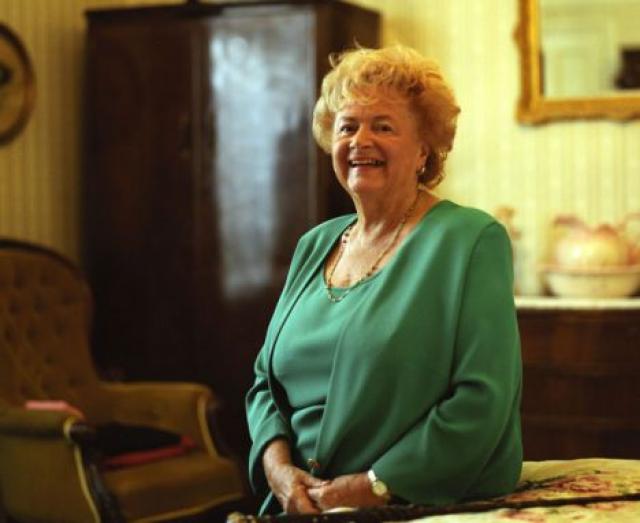
Cynthia Payne
 Great Britain
Cynthia Payne was a British brothel keeper, party hostess and media personality whose suburban London house became the focus of a notorious police raid. Known as “Madam Cyn,” she turned a criminal case into an unlikely public career, appearing in interviews, inspiring books and film, and campaigning for changes to Britain’s sex laws.
The Streatham House
Born in Bognor Regis in 1932, Payne later settled in south London. In the 1970s, she ran parties from her home in Streatham, where clients could use luncheon vouchers as payment for food and drink while buying sexual services. The vouchers became a comic shorthand in newspaper coverage, but they also helped make her case a national story. Police raided the house in 1978.
In 1980, Payne was convicted of keeping a disorderly house and initially sentenced to 18 months in prison. On appeal, the sentence was reduced to six months and a fine. A second high-profile trial in 1987, on a charge of controlling prostitutes, ended in her acquittal. By then, she had become a familiar public figure, using her candid, humorous manner to speak about sex and the legal system.
Books, Film and Politics
Paul Bailey’s 1982 book An English Madam: The Life and Work of Cynthia Payne brought her story to a wider readership. The 1987 comedy-drama Personal Services, directed by Terry Jones and starring Julie Walters, was inspired by her experiences. Payne later worked as an after-dinner speaker and media commentator, maintaining a public presence that was unusual for someone whose notoriety began with a criminal prosecution.
She also tried to turn her views on sexual law into electoral politics. In 1988, she stood in the Kensington by-election as the candidate of the Rainbow Alliance Payne and Pleasure Party, advocating reform of Britain’s sex laws. She did not win, but the campaign extended the public image she had cultivated: irreverent, outspoken and determined to challenge respectability.
Legacy
Payne died in London in 2015, aged 82. Her life attracted attention because it combined courtroom drama, comedy and a challenge to British attitudes toward sex work. Whether in the press, on television or in the film inspired by her story, she presented herself as a showwoman who refused to be reduced to the charges that had first made her famous.


