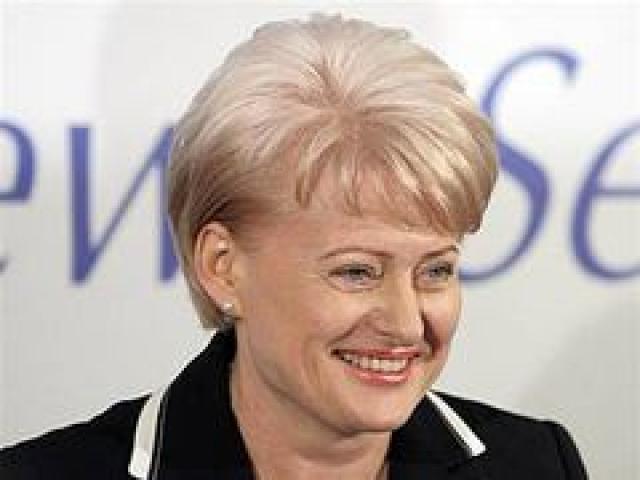
Dalia Grybauskaite
 Lithuania
- Early Life and Education
- Academic and Research Career
- Diplomatic and Governmental Experience
- Finance and Public Office
- European Commissioner
- Presidential Candidacy
- Personal Life
Early Life and Education
Dalia Grybauskaitė was born on March 1, 1956, in Vilnius, Lithuania. From 1975 to 1976, she worked in the human resources department of the State Philharmonic Society of the Lithuanian SSR. In 1976, she began studying economics at the evening division of the Leningrad State University named after A. Zhdanov. While attending university, Grybauskaitė worked at the Leningrad fur factory "Rot-Front" as a worker and laboratory assistant. In 1983, she graduated with a degree in political economy.
Academic and Research Career
Upon returning to Lithuania in 1983, Grybauskaitė became the head secretary of the Academy of Sciences of Lithuania. From 1983 to 1990, she taught political economy at the Vilnius Higher Party School and headed the Department of Agriculture. In 1988, she defended her thesis on "The Interrelation of Social and Personal Property in the Functioning of Personal Subsidiary Households" at the Academy of Social Sciences under the Central Committee of the Communist Party of the Soviet Union in Moscow, earning a Candidate of Economic Sciences degree in political economy of socialism.
Diplomatic and Governmental Experience
In the early 1990s, Grybauskaitė held several diplomatic positions, including Director of the European Department of the Ministry of International Economic Relations of Lithuania and Head of the European Integration Department of the Ministry of Foreign Affairs of Lithuania. From 1994 to 1995, she served as Ambassador Extraordinary and Plenipotentiary to the Lithuanian Mission to the European Union and Deputy Chief Coordinator for Negotiations on Lithuania's Accession Treaty. Between 1996 and 1999, she was Minister Plenipotentiary at the Lithuanian Embassy in the United States.
Finance and Public Office
In 1999, Grybauskaitė became Vice Minister of Finance, leading negotiations with the International Monetary Fund and the World Bank. She also briefly headed the board of directors of the Lithuanian state-owned Savings Bank (Taupomasis Bankas) in 2000. In the same year, she was appointed Vice Minister of Foreign Affairs.
In July 2001, Grybauskaitė was appointed Minister of Finance in the social democratic government of Algirdas Brazauskas, a position she held until 2004. During her tenure, Lithuania's budget deficit was reduced from 8.5% to 1.2% of GDP.
European Commissioner
After Lithuania joined the European Union in 2004, Grybauskaitė was nominated to the European Commission. Initially responsible for culture and education, she became the Commissioner responsible for financial planning and budget in November 2004. In this role, Grybauskaitė gained significant popularity both in Lithuania and internationally. She was nicknamed "Iron Lady" by The Wall Street Journal in 2004 and compared to Margaret Thatcher. In 2005, European Voice magazine named Grybauskaitė "Commissioner of the Year" for her efforts in reforming the EU budget.
Grybauskaitė remained an outspoken critic of the Lithuanian government's economic policies, leading to accusations of politicking by Prime Minister Gediminas Kirkilas in 2008.
Presidential Candidacy
On February 26, 2009, Grybauskaitė announced her intention to run for President of Lithuania as an independent candidate. Her candidacy was linked to the deteriorating economic situation in the country, which had led to riots outside the Lithuanian parliament building in January 2009. In accordance with European Commission regulations, Grybauskaitė suspended her duties as EU Commissioner from mid-April 2009.
Personal Life
Grybauskaitė is proficient in Lithuanian, English, Russian, Polish, and French. She holds a black belt in karate and is not married.


