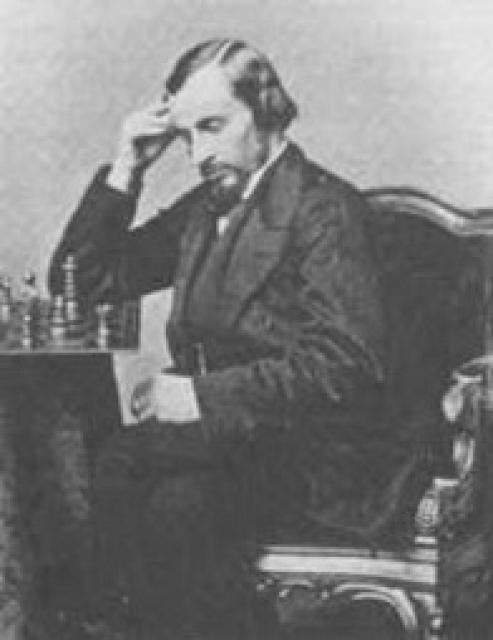
Daniel Harrwitz
 Germany
- Daniel Harrwitz: The German Chess Master
- Early Career and Matches
- Continued Successes and Journalism
- Matches Against Chess Giants
- Legacy and Recognition
Daniel Harrwitz: The German Chess Master
Daniel Harrwitz was a German chess master who lived in the mid-19th century. He was considered one of the strongest players in Europe during his time and made significant contributions to chess literature.
Early Career and Matches
Harrwitz played his first major match in 1846 against the legendary Howard Staunton. Despite giving Staunton odds (such as the f7 pawn and a 1-2 move advantage), Harrwitz lost by a narrow margin of 9 wins to 12 losses with 1 draw. However, he went on to win matches against James Walker (5:3), Elijah Williams (3:2), and John Medley (11:7) that same year. In 1848, he drew a close match against the renowned Adolf Anderssen in Breslau, with a score of 5 wins each.
Continued Successes and Journalism
From 1848 to 1953, Harrwitz continued his winning streak, defeating Carl Mayet (+5 ?2 =2), Bernhard Horwitz (+7 ?6 =2), Elijah Williams (again in 1852: +7 ?0 =3 and 1853: +7 ?2 =3), Josef Sen (+3 ?1 =1), and Isidor Löwenthal (+11 ?10 =10). During this time, he also published the chess journal "British Chess Review" in London from 1853 to 1854.
Matches Against Chess Giants
In 1858, Harrwitz lost a short match to Anderssen (+1 ?3 =3). However, he achieved a remarkable feat by defeating Paul Morphy in their preliminary game and two match games. Although Morphy ultimately won the match by a margin of 5 wins to 2 losses and 1 draw, Harrwitz's performance was impressive, as no other player in the world had come close to matching Morphy's dominance at the time.
Legacy and Recognition
Harrwitz's contemporaries held his chess skills in high esteem. The "Chess Sheet" wrote in 1858, "He undoubtedly belongs to the number of greatest chess players of our time. Remarkable originality, extreme subtlety of thought, and great speed—these constitute the distinguishing features of his talent."
Harrwitz's contributions to chess extended beyond his playing career. He authored a comprehensive textbook on chess in 1862, which provided valuable instruction to aspiring players for many years. He also played an important role in promoting the game through his writing and established a lasting legacy as one of Europe's finest chess masters of the mid-19th century.


