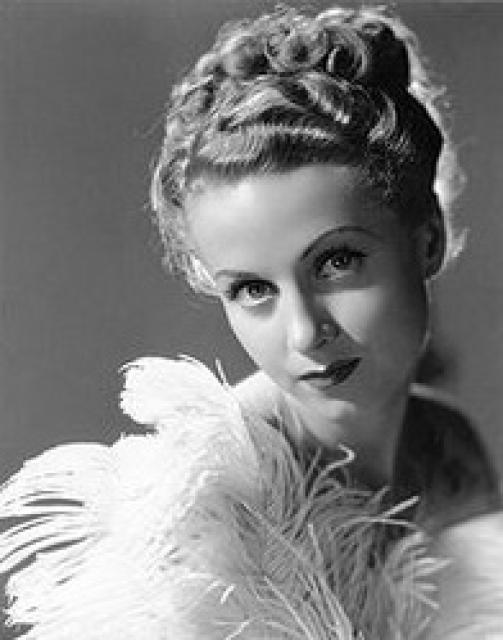
Danielle Darrieux
 France
- Early Life and Career
- Marriage to Henri Decoin
- International Breakthrough
- Return to France and World War II
- Third Marriage and Return to Hollywood
- Collaboration with Max Ophüls
- Honorary César and Later Career
- Personal Life and Legacy
Early Life and Career
Danièle Yvonne Marie Antoinette Darrieux was born in Bordeaux, France, on May 1, 1917. The daughter of a military doctor, she moved to Paris as a child when her father passed away. Darrieux studied cello and piano at the Paris Conservatory. At the age of 14, she made her film debut in the musical "Le Bal" (1931).
In the early stages of her career, Darrieux frequently played mischievous teenagers in films alongside major stars of pre-war French cinema, including Jean-Pierre Aumont, Henri Garat, Pierre Mingand, and notably Albert Préjean, with whom she starred in several films: "Volga en Flammes" (1933), "La Crise Est Finie" (1934), "L'Or dans la Rue" (1934), "Dédé" (1934), "Le Contrôleur des Wagons-Lits" (1935), "Quelle drôle de gosse!" (1935), and "Caprices" (1941).
Marriage to Henri Decoin
In 1935, Darrieux married French writer, screenwriter, and director Henri Decoin, whom she had met the previous year on the set of "L'Or dans la Rue." She went on to star in numerous comedies and melodramas directed by Decoin, including "J'aime toutes les femmes" (1935), "Le Domino Vert" (1935), "Abus de Confiance" (1937), "Retour à l'Aube" (1938), "Mademoiselle, ma Mère" (1938), "Battement de Coeur" (1939), "Amour Premier" (1940), and "L'Affaire des Poisons" (1955).
International Breakthrough
In 1936, director Anatole Litvak cast Darrieux in "Mayerling," where she played Maria Vetsera opposite Charles Boyer as Archduke Rudolf of Austria. The film was an international success, bringing her to the attention of Hollywood directors. Encouraged by Decoin, she traveled to Hollywood with her husband in 1938 and signed a seven-year contract with Universal. Darrieux's first major Hollywood role was in "The Rage of Paris," starring opposite Douglas Fairbanks Jr.
In 1938, director Maurice Tourneur cast Darrieux in the historical melodrama "Katia," about the love affair between Princess Catherine Dolgoruky and Emperor Alexander II.
Return to France and World War II
In the spring of 1942, Darrieux visited Germany as part of a delegation of French film actors. In 1947, she starred in Jean Cocteau's adaptation of Victor Hugo's play "Ruy Blas," directed by Pierre Billon, where she played the Queen of Spain alongside French stage and screen luminaries Jean Marais and Marcel Herrand.
Third Marriage and Return to Hollywood
After divorcing Decoin in 1941, Darrieux married Dominican diplomat Porfirio Rubirosa in 1942, divorcing him in 1947. In 1948, she wed screenwriter George Mittcellinescu, with whom she remained married until his death in 1991.
In the early 1950s, Darrieux returned to Hollywood and appeared in "Rich, Young and Pretty" (1951) and garnered critical acclaim for her performance in the suspense drama "5 Fingers" (1952).
Collaboration with Max Ophüls
Director Max Ophüls cast Darrieux in several of his films, which became career highlights: In "La Ronde" (1950), Darrieux played a bourgeois woman dissatisfied with both her husband and her lover; in "Le Plaisir" (1952), she portrayed a prostitute (again opposite Jean Gabin); and in "Madame de..." (1953), she delivered one of her finest performances as a socialite entangled in a web of her own desires—a film that starts as a light comedy and gradually transforms into a dark drama. Darrieux starred alongside Charles Boyer and Vittorio De Sica.
Honorary César and Later Career
In 1954, Darrieux played Madame Louise de Rênal in Claude Autant-Lara's adaptation of Stendhal's novel "The Red and the Black," opposite iconic French actor Gérard Philipe. For her performance, Darrieux received the L'Étoile de Cristal, the highest national film award in France, in 1955. She would later star with Philipe again in Julien Duvivier's "Dangerous Liaisons" (1957), based on Émile Zola's novel "Pot-Bouille."
Darrieux's final Hollywood film was "Alexander the Great" (1956), where she played Olympias, the mother of Alexander the Great, alongside Richard Burton and Claire Bloom.
In 1985, Darrieux was awarded an honorary César for her contributions to cinema. She continued to act in films and television until well into her 90s, notably appearing in François Ozon's satirical black comedy "8 Women" (2001), which earned her a Silver Bear at the Berlin Film Festival and a European Film Award for Best Actress, shared with the film's ensemble cast.
Personal Life and Legacy
Darrieux was married three times. Her first two marriages, to Henri Decoin and Porfirio Rubirosa, ended in divorce. In 1948, she married screenwriter George Mittcellinescu, with whom she remained married until his death in 1991.
In addition to her film and theater work, Darrieux recorded 20 musical albums as a singer, including a French version of "Podmoskovnye Vechera" (Moscow Nights).
Danièle Darrieux passed away on October 17, 2017, at her home in Normandy at the age of 100. She remains one of the most celebrated and enduring actresses in French cinema history.



